
A piano is a musical instrument made up of many important parts that work together to produce sound and create music. In this blog post, you will learn the parts of a piano with their functions and a diagram to understand how each section of the piano works. From the keys and pedals to the strings and hammers, every part has a specific role in producing musical notes and controlling sound. Learning the names of piano parts helps you understand English vocabulary related to musical instruments, music education, and piano structure commonly used in schools, music classes, and learning activities.
Understanding the Piano
A piano is a musical instrument that makes sound when you press keys. It is used for playing music, learning, and performing. Knowing the parts of a piano is important for beginners because it helps to play correctly and understand how music is made.
A piano is made up of several main parts, each with a specific function. From the keys you press to the pedals you use, every part works together to produce beautiful sound.
Main Parts of a Piano
Keyboard
Keys
The white and black keys that you press to play notes.
Natural keys (white)
Produce the basic notes (C, D, E, F, G, A, B).
Sharp/Flat keys (black)
Change the note slightly, called accidentals.
Hammers
Hammers
Small felt-covered sticks inside the piano. When a key is pressed, the hammer strikes the string to make sound.
Strings
Strings
Metal wires that vibrate to produce sound.
Bass strings
Thick strings for low notes.
Treble strings
Thin strings for high notes.
Soundboard
Wooden board that amplifies the sound from the strings, making it louder and clear.
Pedals
Damper pedal (Right)
Sustains notes, so they continue after releasing the key.
Soft pedal (Left)
Makes the sound softer.
Sostenuto pedal (Middle)
Holds only some notes while others can be played normally.
Frame and Case
Frame
Metal structure that holds the strings tightly.
Case
The outer wood that protects all piano parts and gives it a beautiful appearance.
Detailed Functions of Piano Parts
Keys
Start the sound by pressing.
Hammers
Hit the strings to create vibration.
Strings
Make sound through vibration.
Soundboard
Amplifies the sound.
Pedals
Change how notes sound.
Frame
Keeps the piano strong and stable.
Case
Protects the piano and looks nice.
Types of Pianos
Grand Piano
- Horizontal strings and hammers.
- Large soundboard for loud and rich sound.
Upright Piano
- Vertical strings and hammers.
- Fits smaller spaces but produces slightly less sound.
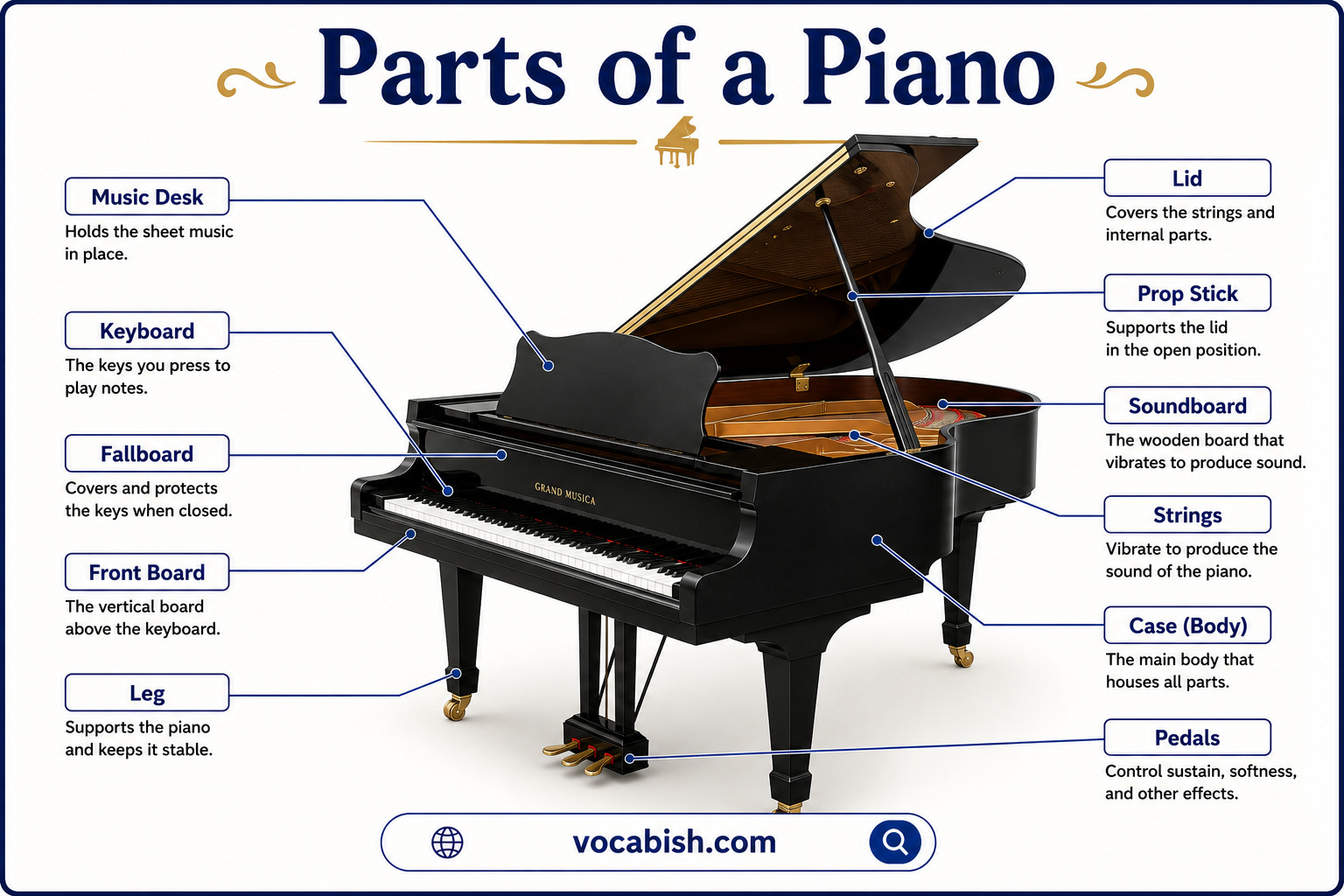
Parts of a Piano Diagram
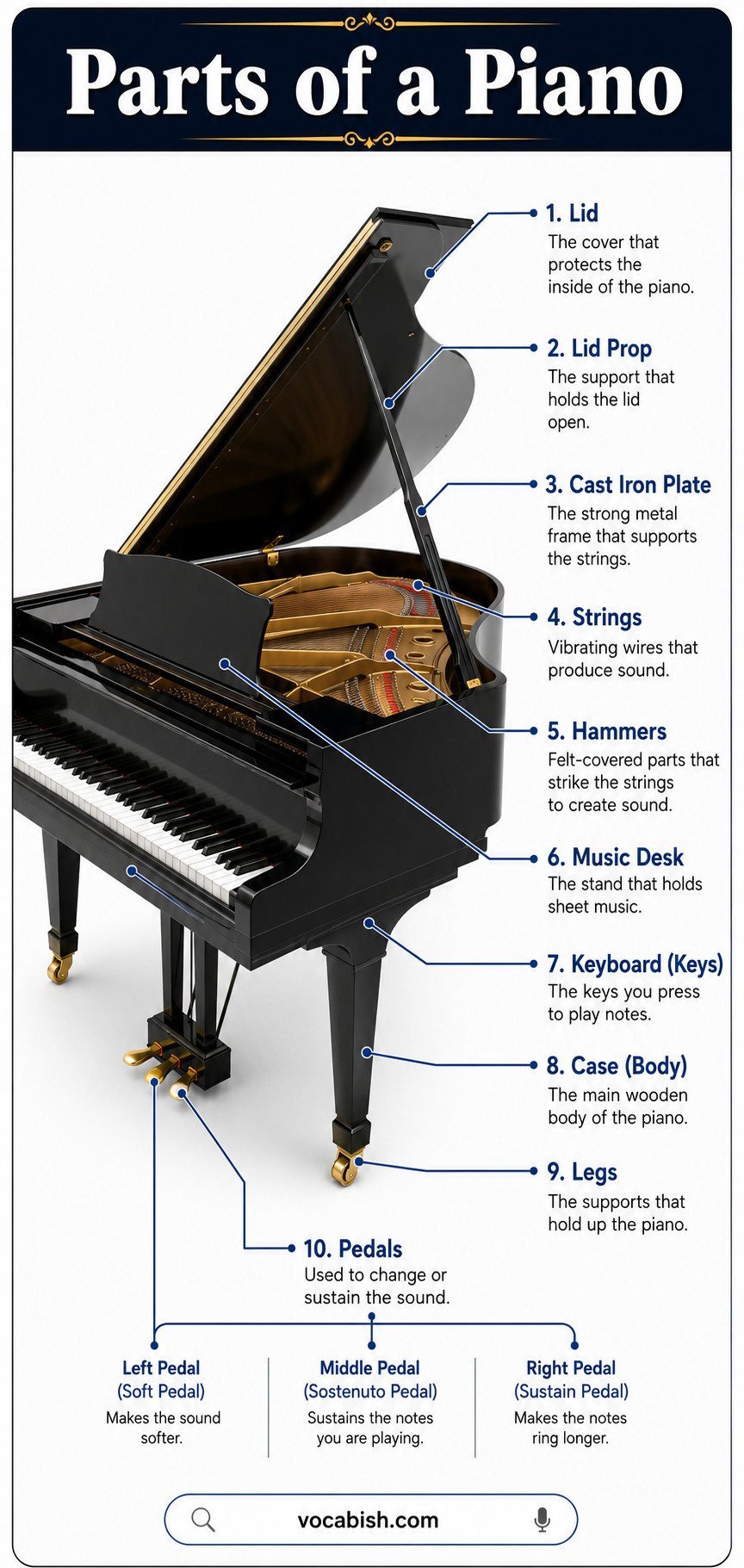
Understanding the parts of a piano helps you play better and take care of the instrument. Each part, from keys to pedals, has a specific role to make music. Learning these parts is the first step for beginners and anyone who loves music.
Frequently Asked Questions
The main parts of a piano are keys, hammers, strings, soundboard, pedals, frame, and case. Each part works together to produce sound.
The soundboard amplifies the vibration from the strings, making the piano sound louder and richer.
When you press a key, the hammer strikes the corresponding string, causing it to vibrate and produce sound.
Piano pedals change the sound: the damper pedal sustains notes, the soft pedal lowers volume, and the sostenuto pedal holds specific notes.
Keys allow you to play notes. White keys produce natural notes, and black keys produce sharp or flat notes.
Bass strings are thick and produce low notes, while treble strings are thin and produce high notes.
The frame holds all the strings tightly and keeps the piano strong and stable.
Related Articles: