
Have you ever looked at a shower and wondered what each part is called? Parts of a Shower include much more than the showerhead. A typical shower may have a shower arm, valve, handle, trim plate, hose, drain, and water controls, with each part serving a different purpose.
Learning these shower parts helps you understand bathroom vocabulary, follow installation instructions, describe a problem, and communicate more confidently in English.
What Are the Parts of a Shower?
The parts of a shower are the fixtures and components that deliver, control, direct, and drain water in a shower area.
The most common parts are:
- Showerhead — sprays water onto the person.
- Shower arm — connects the showerhead to the water pipe in the wall.
- Shower valve — controls water flow and temperature.
- Shower handle — lets you adjust the water.
- Trim plate — covers the opening around the valve.
- Handheld showerhead — provides a movable stream of water.
- Shower hose — connects a handheld showerhead to its water outlet.
- Shower drain — carries used water away.
- Drain cover — covers and protects the drain opening.
- Diverter — directs water between different outlets, such as a fixed showerhead and handheld showerhead.
Not every shower has all of these components. The exact parts depend on the shower design and plumbing system.
Parts of a Shower with Functions
Here is one large reference table showing the most common shower parts names and what each part does.
Shower Part | Function |
|---|---|
Showerhead | Sprays water over the user and controls the shape of the water stream. |
Shower Arm | Connects the showerhead to the water supply pipe inside the wall. |
Shower Flange | Covers the opening where the shower arm enters the wall. |
Shower Valve | Controls the flow and temperature of shower water. |
Shower Handle | Allows the user to turn the water on, off, or adjust its temperature and flow. |
Trim Plate | Covers and finishes the area around the shower valve. |
Cartridge | Controls water flow and temperature inside many modern shower valves. |
Thermostatic Valve | Maintains a selected water temperature and helps prevent sudden temperature changes. |
Pressure-Balancing Valve | Adjusts water pressure between hot and cold supplies to reduce temperature changes. |
Diverter Valve | Directs water to different outlets, such as a showerhead or tub spout. |
Handheld Showerhead | Provides a movable spray that can be held in the hand. |
Shower Hose | Carries water between the supply connection and a handheld showerhead. |
Wall Bracket | Holds a handheld showerhead in a fixed position when it is not being held. |
Body Spray | Releases water horizontally from the shower wall. |
Rain Showerhead | Produces a broad downward spray designed to feel like rainfall. |
Shower Rail | Supports a handheld showerhead and may allow its height to be adjusted. |
Shower Outlet | Provides a connection point for a handheld shower hose or another water outlet. |
Shower Drain | Removes used water from the shower floor. |
Drain Cover | Covers the drain opening while allowing water to pass through. |
Waste Pipe | Carries wastewater from the drain toward the household drainage system. |
Shower Tray | Forms the shower floor and directs water toward the drain in many shower designs. |
Shower Floor | The surface where the user stands while showering. |
Shower Door | Opens and closes to provide access while helping contain water. |
Shower Screen | A glass or other panel that separates the shower area from the rest of the bathroom. |
Shower Curtain | Hangs around the shower area to help keep water inside. |
Curtain Rod | Supports a shower curtain above the shower area. |
Grab Bar | Provides a secure handhold for support and balance. |
Soap Dish | Holds soap or other small bathing products. |
Shampoo Shelf | Provides storage for shampoo, conditioner, and similar products. |
Parts of a Shower Diagram
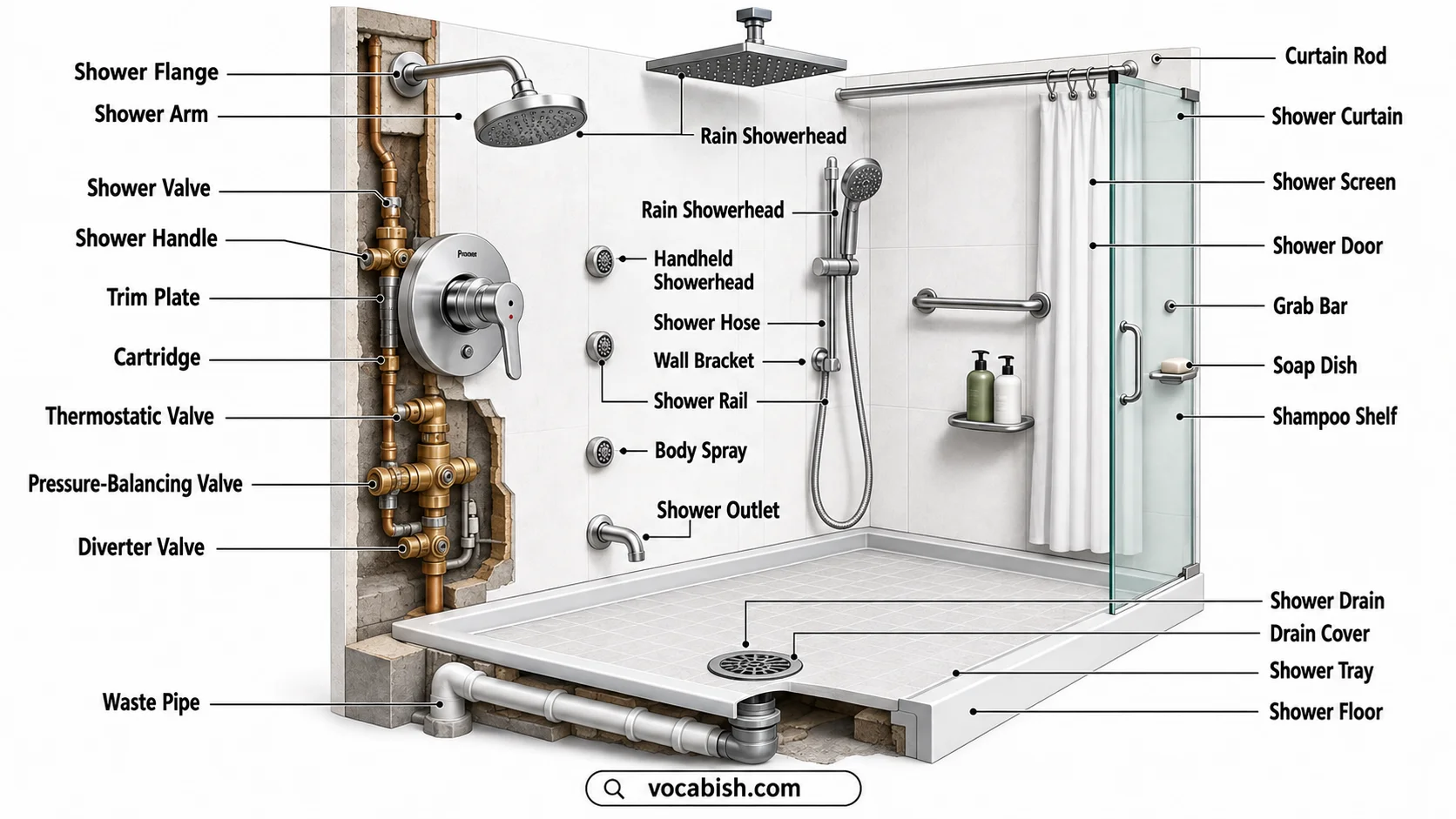
Main Shower Parts Explained
Understanding the main components is easier when you group them by their job: spraying water, controlling water, and removing water.
Showerhead
The showerhead is the part that sprays water onto your body. It may produce a wide spray, concentrated stream, massage spray, or rainfall-style flow.
Example:
“Please clean the showerhead because the water pressure is low.”
Shower Arm
The shower arm is the short pipe extending from the bathroom wall. The showerhead attaches to its end.
Its main job is to carry water from the pipe inside the wall to the showerhead.
Shower Valve
The shower valve is part of the plumbing system that controls water flow and temperature.
A valve may be:
- Pressure-balancing
- Thermostatic
- Manual
- Diverter-equipped
The valve itself is normally behind the wall, while its controls are visible from the shower area.
Shower Handle
The shower handle is the control that the user turns, pulls, or moves to operate the shower.
Depending on the design, one handle may control both temperature and flow, while another system may use separate controls.
Trim Plate
A trim plate, also called a faceplate, is the decorative plate around the shower handle or valve control.
It covers the opening in the wall and gives the installation a finished appearance.
Handheld Showerhead
A handheld showerhead is attached to a flexible hose, allowing the user to hold and direct the spray.
It is useful when you need to aim water at a specific area rather than standing directly under a fixed showerhead.
Shower Hose
The shower hose is a flexible tube that connects a handheld showerhead to the water outlet.
It allows the showerhead to move freely within the length of the hose.
Diverter
A diverter changes where the water goes.
For example, a shower with both a fixed showerhead and handheld showerhead may use a diverter to send water to either outlet.
Shower Drain
The shower drain removes used water from the shower floor.
A properly positioned drain helps prevent water from collecting around your feet.
Drain Cover
The drain cover sits over the drain opening. It allows water to enter while helping prevent larger objects from entering the drainage pipe.
Types of Showerheads
Showerheads come in different designs, and each produces a different type of water flow.
Showerhead Type | Main Feature |
|---|---|
Fixed Showerhead | Permanently mounted to the wall |
Handheld Showerhead | Connected to a flexible hose |
Rain Showerhead | Wide, gentle downward spray |
Dual Showerhead | Combines fixed and handheld heads |
High-Pressure Showerhead | Produces a stronger, concentrated spray |
Low-Flow Showerhead | Uses less water while maintaining useful spray pressure |
Body Spray | Sprays water from the wall |
Filtered Showerhead | Contains a filtration component |
Shower Types and Their Functions
The word shower can describe different bathroom arrangements, not just different showerheads.
Shower Type | Main Function |
|---|---|
Electric Shower | Provides hot water without relying entirely on stored hot water |
Mixer Shower | Provides adjustable shower temperature |
Thermostatic Shower | Maintains a selected water temperature |
Power Shower | Provides stronger water flow |
Digital Shower | Allows precise control of temperature and settings |
Manual Mixer Shower | Lets the user adjust temperature by hand |
Rain Shower System | Provides broad overhead water coverage |
Handheld Shower System | Allows targeted water flow |
Tub and Shower Combination | Allows bathing or showering in one space |
Walk-In Shower | Provides easy access and a spacious design |
Shower Vocabulary and Useful Terms
Learning the names of shower components can also improve everyday English vocabulary.
Word | Meaning | Example Sentence |
|---|---|---|
Showerhead | A device that sprays water | “The showerhead needs cleaning.” |
Valve | A device that controls water flow | “The valve controls the temperature.” |
Drain | An opening that removes wastewater | “The shower drain is blocked.” |
Hose | A flexible tube for carrying water | “The shower hose is leaking.” |
Handle | A part used to operate the shower | “Turn the handle slowly.” |
Diverter | A control that changes the water outlet | “Use the diverter for the handheld shower.” |
Spray | Water released in small streams or drops | “The spray is too strong.” |
Flow | The movement or amount of water | “The water flow is weak.” |
Temperature | How hot or cold the water is | “Check the water temperature.” |
Pressure | The force with which water moves | “The shower has low water pressure.” |
Leak | Water escaping from an unwanted place | “There is a leak near the valve.” |
Fixture | A permanently installed bathroom fitting | “The shower fixture is made of metal.” |
Pronunciation of Common Shower Words:
- Shower — /ˈʃaʊər/
- Showerhead — /ˈʃaʊərhed/
- Valve — /vælv/
- Drain — /dreɪn/
- Hose — /hoʊz/
- Diverter — /daɪˈvɜːrtər/
- Fixture — /ˈfɪkstʃər/
Common Confusions About Shower Parts
Some shower terms sound similar or describe parts that perform related jobs.
- Showerhead vs. shower arm: The showerhead sprays water; the shower arm connects it to the wall pipe.
- Valve vs. handle: The valve controls water inside the plumbing; the handle is the visible control used by the person.
- Drain vs. drain cover: The drain carries wastewater away; the cover sits over its opening.
- Shower hose vs. shower arm: A hose is flexible and usually serves a handheld showerhead; an arm is a fixed pipe.
- Diverter vs. valve: A diverter changes the water outlet, while a shower valve primarily controls water flow and temperature.
FAQs About Parts of a Shower
The main parts include the showerhead, shower arm, valve, handle, trim plate, water outlet, and drain.
The shower valve controls water temperature, while the handle or control lets the user adjust the selected temperature.
The pipe connecting a wall water supply to a fixed showerhead is called a shower arm.
The opening that removes wastewater is called the shower drain, usually covered by a drain cover.
A fixed showerhead stays mounted in one position, while a handheld showerhead connects to a flexible hose.
A shower diverter directs water between different outlets, such as a fixed showerhead, handheld showerhead, or tub spout.
The plate surrounding a shower handle is commonly called a trim plate, trim, or escutcheon.
A mixer combines hot and cold water manually, while a thermostatic shower automatically regulates water temperature more precisely.
Conclusion
Knowing the Parts of a Shower makes bathroom vocabulary easier to understand and use. The showerhead sprays water, the valve controls it, the handle operates the controls, and the drain removes wastewater.
Once you know these shower parts, you can describe bathroom fixtures, understand repair instructions, identify components in a parts of a shower diagram, and communicate more clearly in everyday English.
Explore More Parts of Things