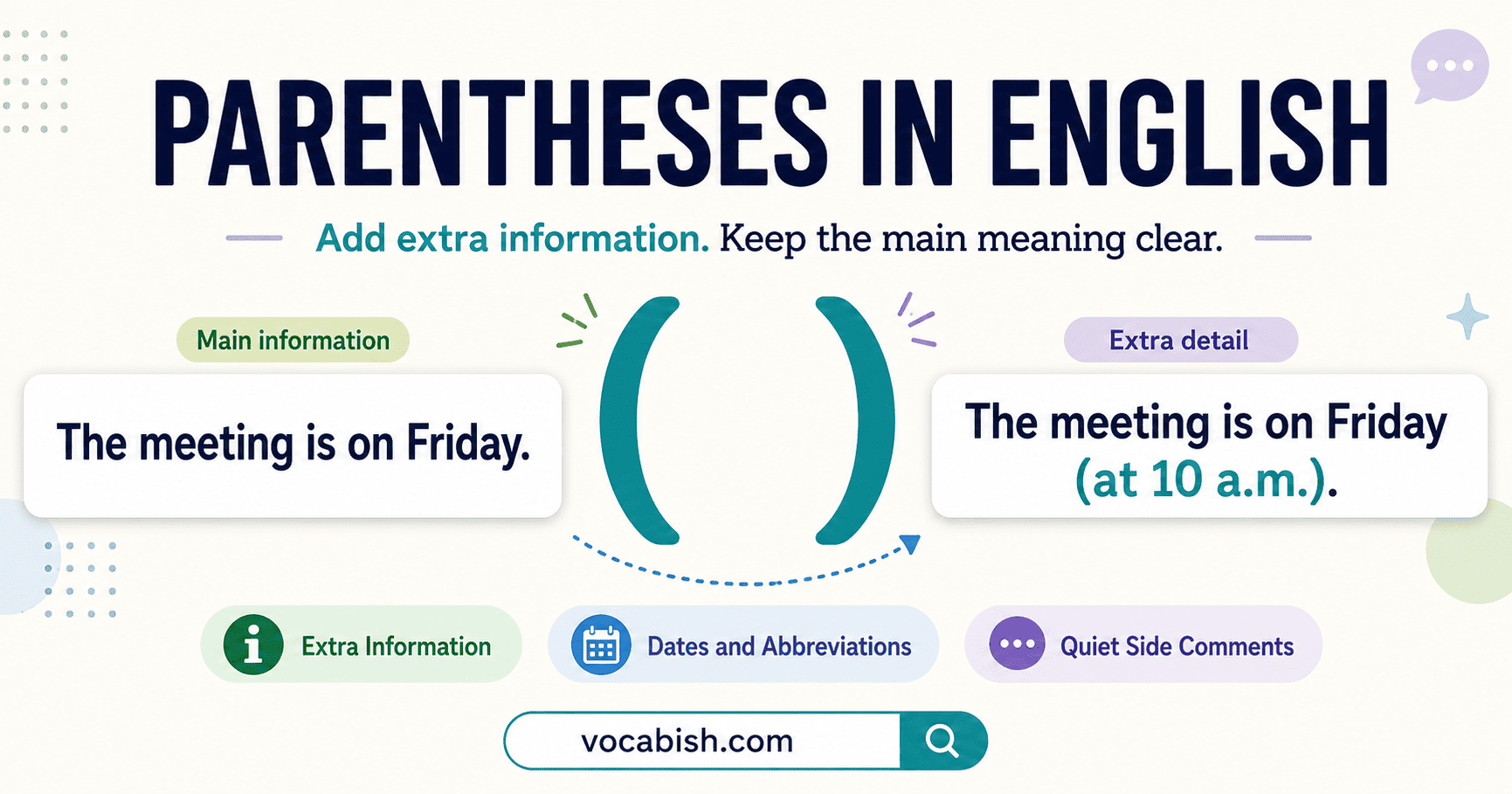

Parentheses ( ) are punctuation marks used to enclose additional information. In British English, they are also called round brackets.
The information inside parentheses may explain, clarify, identify, or add a small detail. It is usually non-essential, which means the main sentence remains complete when the parenthetical information is removed.
- With parentheses: The conference will be held in Lahore (Pakistan’s second-largest city).
- Without parentheses: The conference will be held in Lahore.
Both sentences are complete, but the first provides extra information.
Adding Non-Essential Information
Parentheses help separate information that is useful but not central to the sentence.
Additional details
Use parentheses to include background information without interrupting the main message.
- The museum (which opened in 1985) attracts thousands of visitors.
- Our new manager (a former English teacher) will begin on Monday.
- The road remained closed for two hours (possibly because of flooding).
The sentence should still make grammatical sense after removing the parentheses:
- The museum attracts thousands of visitors.
- Our new manager will begin on Monday.
- The road remained closed for two hours.
Dates and identifying information
Parentheses can provide dates, locations, ages, and other identifying details.
- William Shakespeare (1564–1616) wrote many famous plays.
- The meeting took place in Multan (Punjab).
- The youngest participant (aged twelve) completed the race.
- The company opened its first branch in 2012 (the same year its website launched).
Abbreviations
Write the full term first and place its abbreviation in parentheses. The abbreviation can then be used alone.
- The World Health Organization (WHO) published the report.
- English as a Second Language (ESL) courses are available online.
- The United Nations (UN) was established in 1945.
Do not repeatedly place the abbreviation in parentheses after introducing it once.
Comments and brief explanations
A writer may use parentheses to add a personal comment, clarification, or minor observation.
- The journey took six hours (far longer than expected).
- He finally replied (after three reminders).
- Sara brought dessert (her homemade chocolate cake).
Parenthetical comments should remain short. Long explanations are usually clearer as separate sentences.
Parentheses with Complete Sentences
A complete sentence can appear inside parentheses, but its punctuation depends on its position.
A separate parenthetical sentence
When the entire parenthetical statement stands separately, begin it with a capital letter and place the closing punctuation inside.
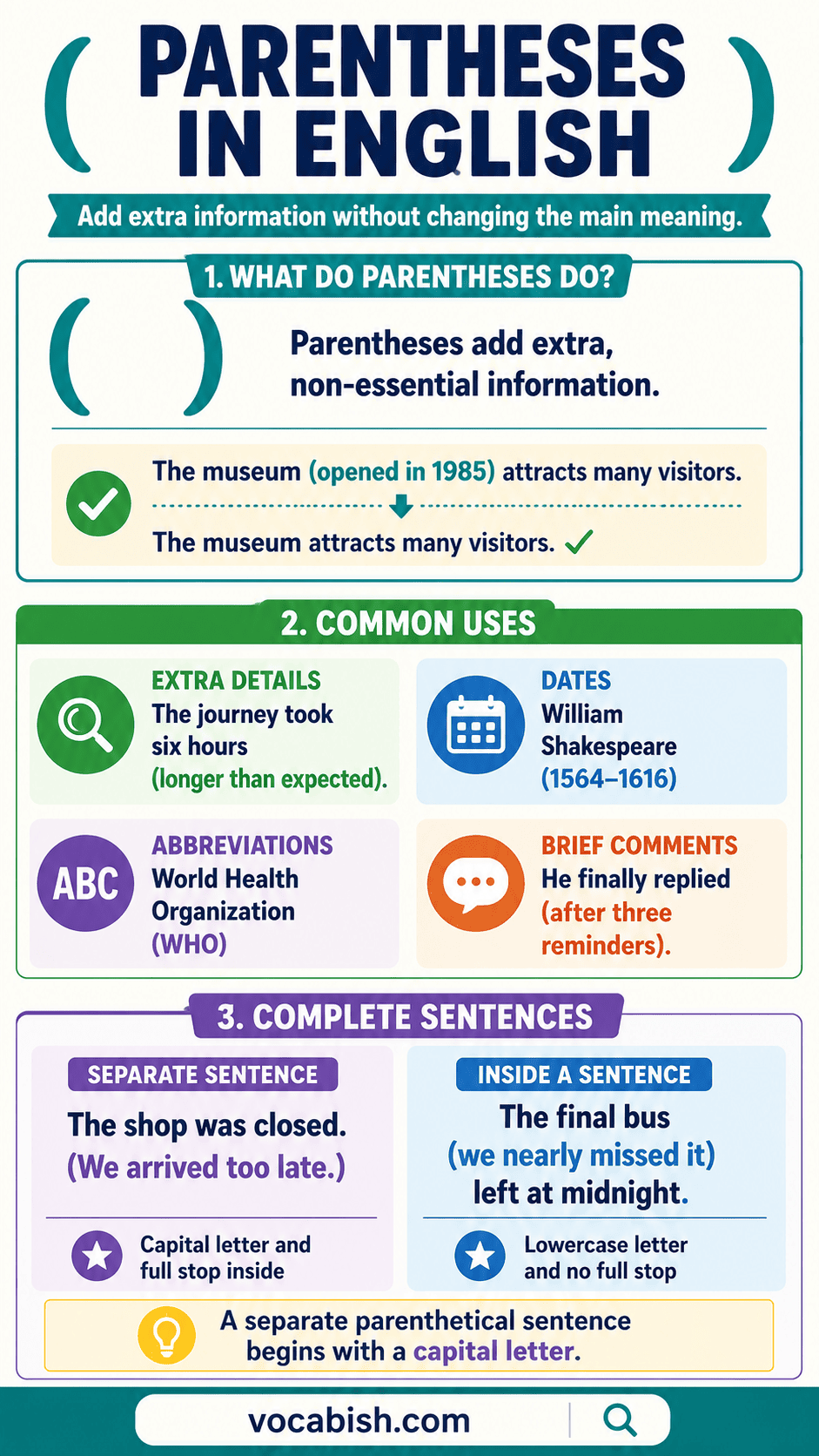
- The shop was already closed. (We arrived ten minutes too late.)
- The results will be announced tomorrow. (Check the website after midday.)
- She did not attend the meeting. (No explanation was provided.)
The parenthetical sentence is grammatically independent from the sentence before it.
A complete thought within another sentence
When parenthetical information appears inside a larger sentence, it normally begins with a lowercase letter and does not take a full stop.
- The final bus (we nearly missed it) left at midnight.
- His explanation (nobody found it convincing) created more confusion.
- The committee (it meets every Friday) will review the application.
Although these examples are possible, they can feel awkward. Commas or dashes may produce a more natural sentence:
- The committee, which meets every Friday, will review the application.
- His explanation—nobody found it convincing—created more confusion.
Several sentences inside parentheses
Two or more sentences may appear inside parentheses when they form a separate comment.
- The office will remain closed tomorrow. (The building is being inspected. Staff members will work from home.)
Use this structure sparingly. A long parenthetical section can distract readers from the main point.
Punctuation Inside and Outside Parentheses
The position of punctuation depends on whether it belongs to the main sentence or only to the parenthetical information.
Situation | Rule | Example |
|---|---|---|
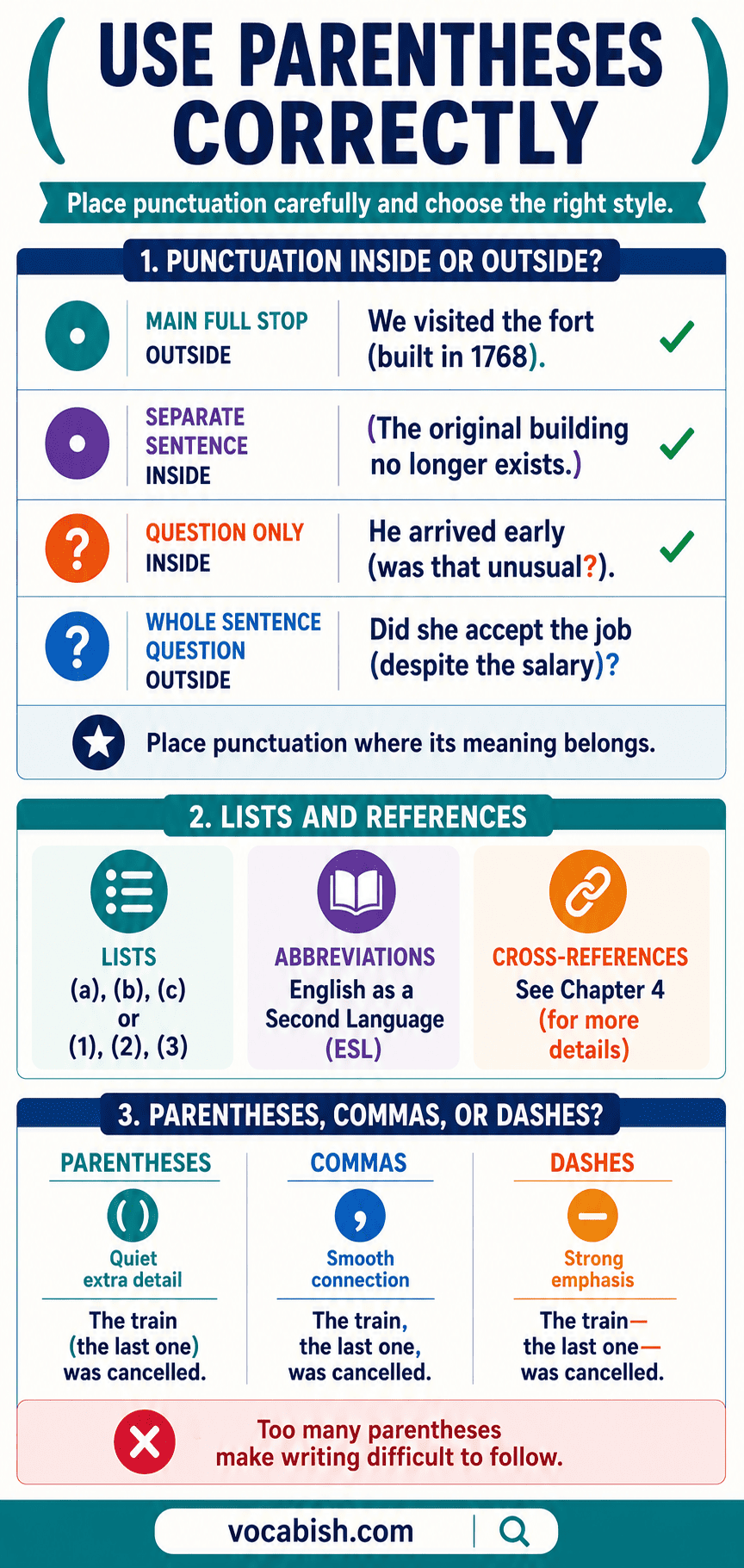
Parentheses appear within a sentence | Put the main sentence’s punctuation outside | We visited the old fort (built in 1768). |
The entire sentence is parenthetical | Put the full stop inside | (The original building no longer exists.) |
The parenthetical words form a question | Put the question mark inside | He arrived early (was that unusual?) and waited outside. |
The whole sentence is a question | Put the question mark outside | Did she accept the position (despite the lower salary)? |
The parenthetical words express surprise | Put the exclamation mark inside | The repairs cost Rs. 50,000 (what a shock!). |
A comma follows the parenthetical detail | Put the comma after the closing parenthesis | After the announcement (which surprised everyone), the room became silent. |
Full stops
Place the full stop outside when the parenthetical information belongs to the surrounding sentence.
- The flight was delayed (because of heavy rain).
- We stayed at a small hotel (near the railway station).
Place the full stop inside when everything inside the parentheses forms a separate sentence.
- The flight was delayed. (Heavy rain had affected several routes.)
- We stayed at a small hotel. (It was near the railway station.)
Avoid using two full stops:
- Incorrect: The flight was delayed (because of heavy rain.).
- Correct: The flight was delayed (because of heavy rain).
Question marks and exclamation marks
A question mark or exclamation mark goes inside when it applies only to the parenthetical information.
- The package arrived today (can you believe it?).
- He completed the task in ten minutes (an impressive result!).
It goes outside when the whole sentence is a question or exclamation.
- Have you read her latest article (the one about punctuation)?
- What a surprising result that was (especially for a new team)!
Parentheses in Lists and References
Parentheses are often used to organise lists, introduce references, and provide publication details.
Letters and numbers in lists
Parentheses can enclose letters or numbers that identify separate items.
The course covers:
- (a) sentence structure
- (b) punctuation
- (c) academic vocabulary
They may also appear within a sentence:
- Applicants must provide (1) proof of identity, (2) an application form, and (3) two photographs.
Keep the formatting consistent. Do not use (1) for one item and 2. for another item in the same list.
References and citations
Academic and professional writing often uses parentheses for source information.
- Regular reading can improve vocabulary development (Ahmed, 2024).
- The survey included 450 participants (see Appendix B).
- The complete results appear in the final report (pp. 32–35).
Citation rules depend on the required style guide, such as APA, MLA, or Chicago.
Cross-references
Parentheses can direct readers to another part of a document.
- The causes are discussed later (see Chapter 4).
- Several exceptions apply (see the examples below).
- The updated figures appear in the table (Appendix A).
Parentheses vs Commas
Both parentheses and commas can separate non-essential information, but they create different levels of interruption.
Parentheses | Commas |
|---|---|
Make information feel less important | Keep information closely connected to the sentence |
Create a noticeable visual separation | Create a lighter, smoother pause |
Often contain comments, dates, or explanations | Often surround descriptive clauses |
Suggest that the detail could easily be skipped | Suggest that the detail still supports the main message |
Compare:
- My brother (who lives in Karachi) is visiting this weekend.
- My brother, who lives in Karachi, is visiting this weekend.
The first sentence treats the location as a side detail. The second connects it more naturally to the main sentence.
Another comparison:
- The building (constructed during the 1920s) needs major repairs.
- The building, constructed during the 1920s, needs major repairs.
Use parentheses when the detail feels separate. Use commas when the information should flow with the sentence.
Parentheses vs Dashes
Parentheses and dashes can both add extra information, but their emphasis is different.
Parentheses | Dashes |
|---|---|
Present information quietly | Draw strong attention to information |
Reduce the importance of the inserted detail | Emphasise or dramatise the inserted detail |
Create a softer interruption | Create a sharper interruption |
Suit dates, references, and minor explanations | Suit surprising comments or strong clarifications |
Compare:
- The final applicant (a recent graduate) had excellent communication skills.
- The final applicant—a recent graduate—had excellent communication skills.
The parentheses make the detail less prominent. The dashes ask the reader to notice it.
Another example:
- Our train (the last one that evening) was cancelled.
- Our train—the last one that evening—was cancelled.
The second version places stronger emphasis on the inconvenience.