
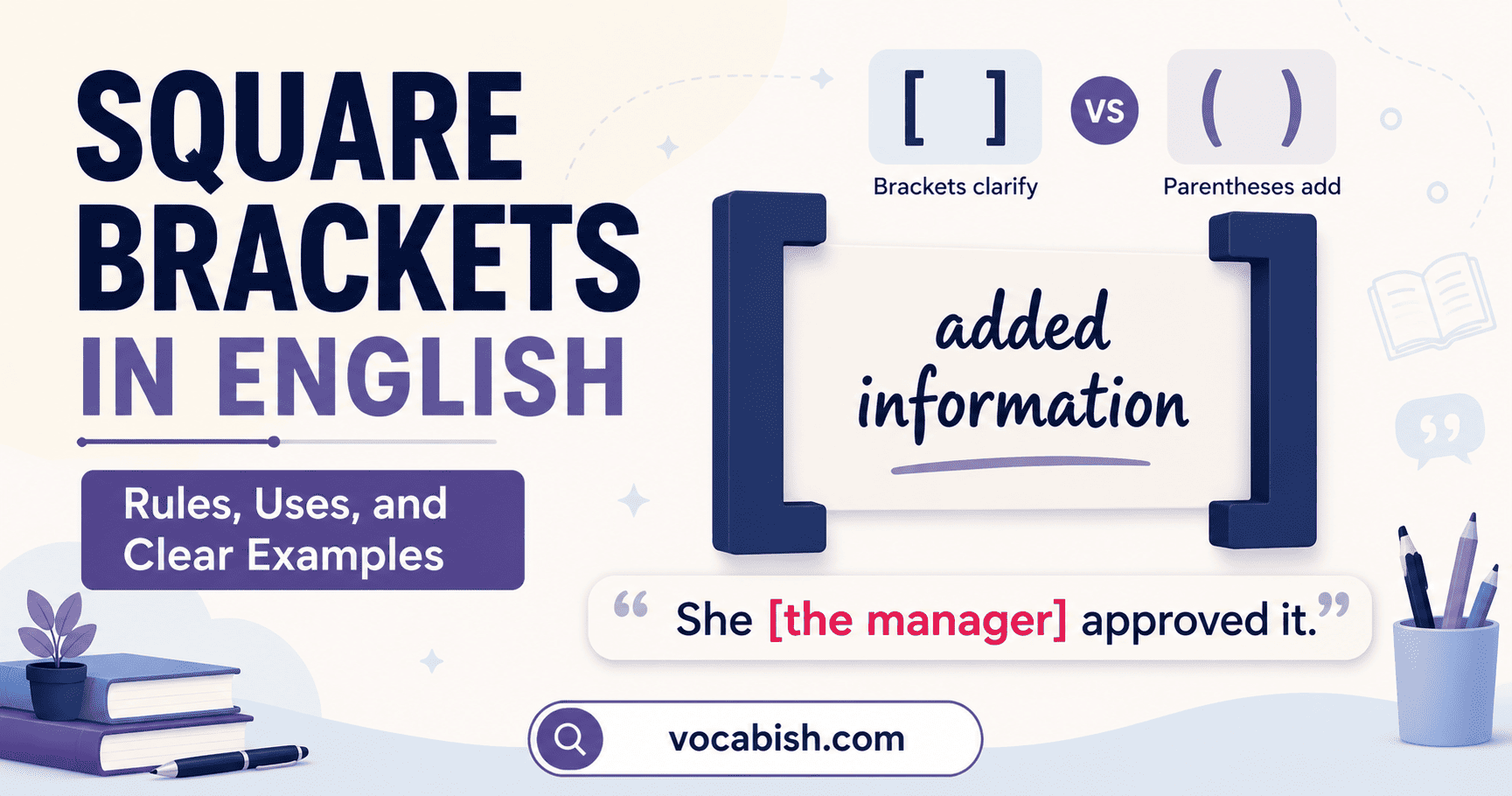

Square brackets punctuation marks added or changed information inside quoted material. They help writers clarify names, explain references, show editorial notes, and separate brackets from parentheses.
Unlike parentheses, square brackets usually contain words that were not part of the original quotation. Their main purpose is to make quoted information easier to understand without misrepresenting the original speaker or writer.
Adding Words inside Quotations
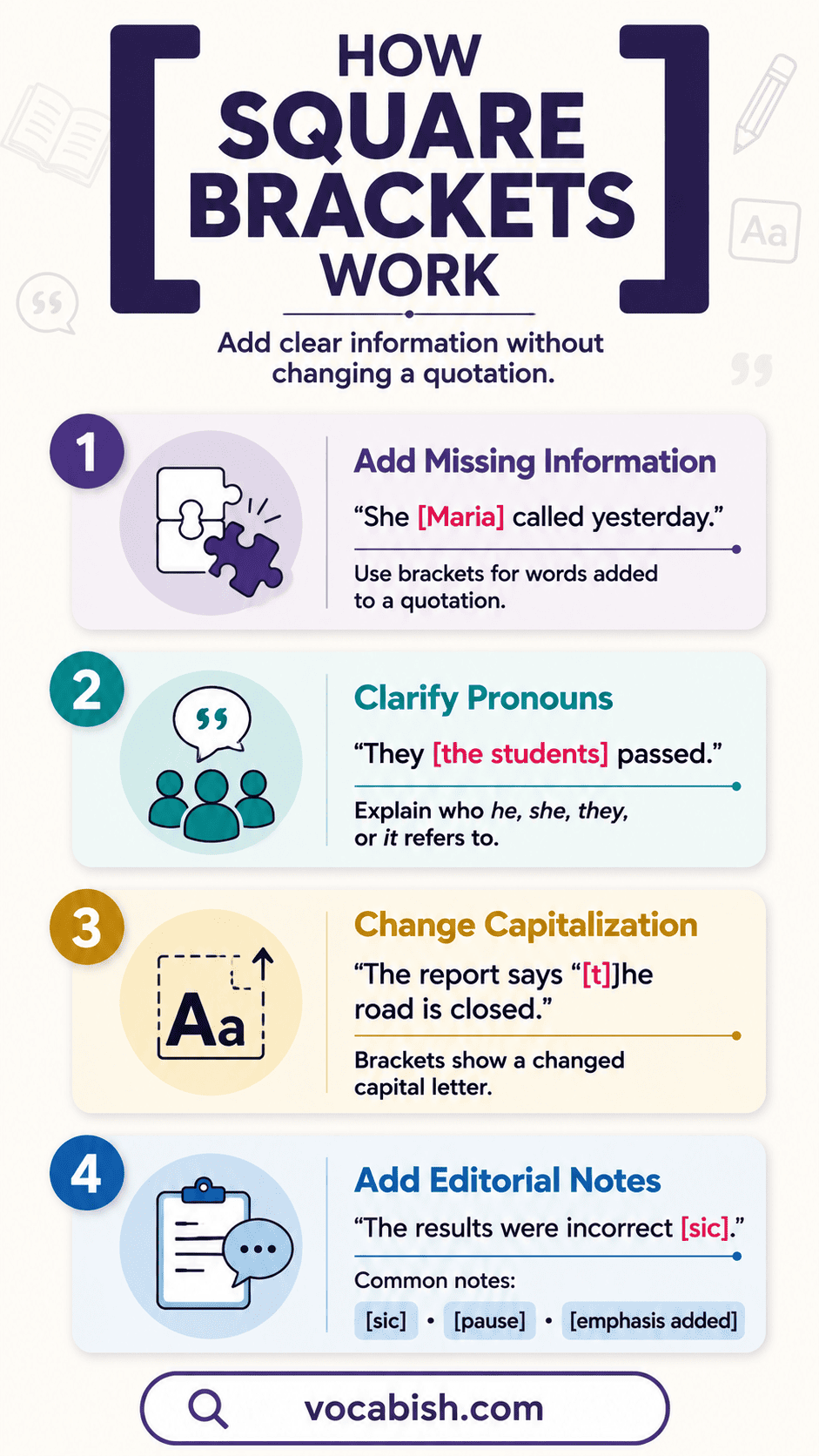
Square brackets allow you to insert helpful words into a direct quotation. The inserted information should clarify the quotation, not change its meaning.
Original statement:
“They will arrive tomorrow.”
The pronoun they is unclear when the sentence appears alone.
Quotation with added information:
The guide explained, “They [the visitors] will arrive tomorrow.”
The words the visitors were added by the person quoting the guide, so they appear inside square brackets.
Original quotation | Quotation with clarification |
|---|---|
“The decision was final.” | “The decision [to close the branch] was final.” |
“It begins in June.” | “It [the training programme] begins in June.” |
“We sent it yesterday.” | “We sent it [the application] yesterday.” |
Remember these points:
- Add only information that the context clearly supports.
- Keep the original meaning unchanged.
- Do not use brackets to insert your own opinion.
- Make the addition as short as possible.
- Check that the completed sentence remains grammatical.
Incorrect:
“The plan [which was obviously a bad idea] failed.”
The bracketed words add personal judgment rather than neutral clarification.
Better:
“The plan [for expanding the factory] failed.”
Clarifying Pronouns and References
Pronouns such as he, she, they, it, and this may become confusing when a quotation is removed from its original context. Square brackets can identify the person, object, place, or idea being discussed.
Original:
“She supported it from the beginning.”
Clarified version:
“She [the head teacher] supported it [the new attendance policy] from the beginning.”
The added words identify both references without hiding the fact that they were not in the original statement.
Square brackets can clarify:
- A person:
[Mr Ahmed] - A group:
[the committee members] - A place:
[the community centre] - An object:
[the missing document] - An earlier statement:
[the proposed rule] - A time reference:
[the following Monday]
Use them carefully. Too many bracketed additions can make a quotation difficult to read.
Heavy and distracting:
“She [the director] told them [the new employees] that it [the revised system] would begin then [the following month].”
Clearer:
According to the director, the revised system would begin the following month. She told the new employees, “It will begin next month.”
Paraphrasing is often better when a quotation requires several explanations.
Changing Capitalization in Quotes
A quoted sentence may need to fit grammatically into your own sentence. Square brackets can show that you changed the capitalization of its first letter.
Original sentence:
“The final results will be published on Friday.”
When the quotation begins in the middle of your sentence:
The announcement confirmed that “[t]he final results will be published on Friday.”
The capital T became a lowercase t, so the changed letter appears in brackets.
Square brackets may also show that a lowercase letter was changed to a capital letter.
Original wording:
The researcher said the evidence “was not strong enough.”
Used as a complete sentence:
The researcher concluded, “[W]as not strong enough” accurately described the available evidence.
That construction is grammatically possible but unnatural. A smoother version would be:
The researcher said the evidence “was not strong enough.”
Change | Example |
|---|---|
Capital to lowercase | She explained that “[t]he road was already closed.” |
Lowercase to capital | The report states, “[T]he road was already closed.” |
No change needed | She explained, “The road was already closed.” |
Some academic and publishing styles allow minor capitalization changes without square brackets. Follow the required style guide when writing formal assignments, reports, or research papers.
Showing Editorial Comments
Editors, reporters, researchers, and transcript writers use square brackets to insert comments that were not spoken or written in the original material.
Common editorial notes include:
[sic][emphasis added][translation mine][name removed][pause][laughs][inaudible][editor’s note]
Using [sic]
The Latin word sic means “thus” or “in this way.” It shows that an error or unusual expression appeared in the original source and was copied exactly.
The notice stated, “All student’s [sic] must register by Friday.”
The apostrophe error belongs to the original notice, not to the writer quoting it.
Use [sic] only when necessary. It should confirm accuracy, not embarrass someone over a minor mistake.
Identifying Added Emphasis
When you add italics or bold formatting to part of a quotation, acknowledge the change:
“The payment must be received before Friday”
[emphasis added].
This tells readers that the original source did not emphasize the word before.
Adding Transcript Information
Square brackets can describe meaningful sounds, actions, or missing speech in a transcript:
“I thought the door was locked. [pause] Then I heard someone upstairs.”
“We completed the first inspection, but the second section was [inaudible].”
Only include actions or sounds that help readers understand the exchange.
Brackets inside Parentheses
When a sentence already contains parentheses and another parenthetical detail is needed inside them, use square brackets for the inner information.
The workshop will be held in the main hall (the room beside the library [not the smaller conference room]).
The punctuation pattern is:
Main sentence (parenthetical information [additional information]).
More examples:
- The survey included 600 participants (see Appendix B [pages 18–22]).
- The event was postponed (because of the storm [and not because of low attendance]).
- Three regions were included in the study (Punjab, Sindh, and Balochistan [urban districts only]).
Nested punctuation can quickly become difficult to follow. Rewrite the sentence when possible.
Crowded:
The results (collected during the second trial [which began in March]) were reviewed in June.
Clearer:
The results were collected during the second trial, which began in March, and reviewed in June.