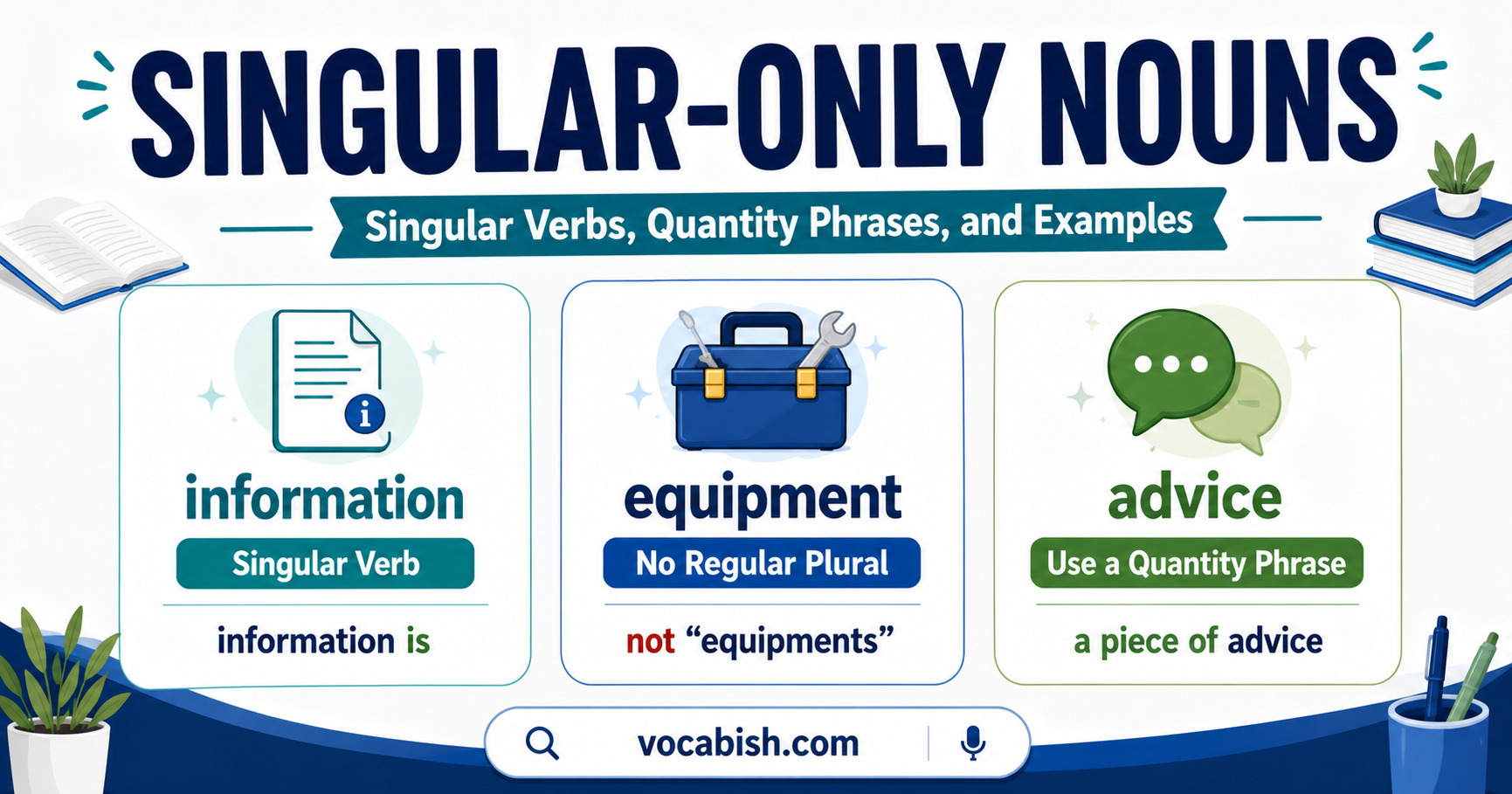

Singular-only nouns are nouns that normally remain singular and take a singular verb in their usual meaning. They do not usually form regular plurals, even when they refer to a large amount of something.
For example, we say The information is useful, not The informations are useful. The important point is not simply whether something can be counted. Learners need to recognise the noun’s fixed singular behaviour and choose the correct verb, determiner, and quantity expression.
What Are Singular-Only Nouns?
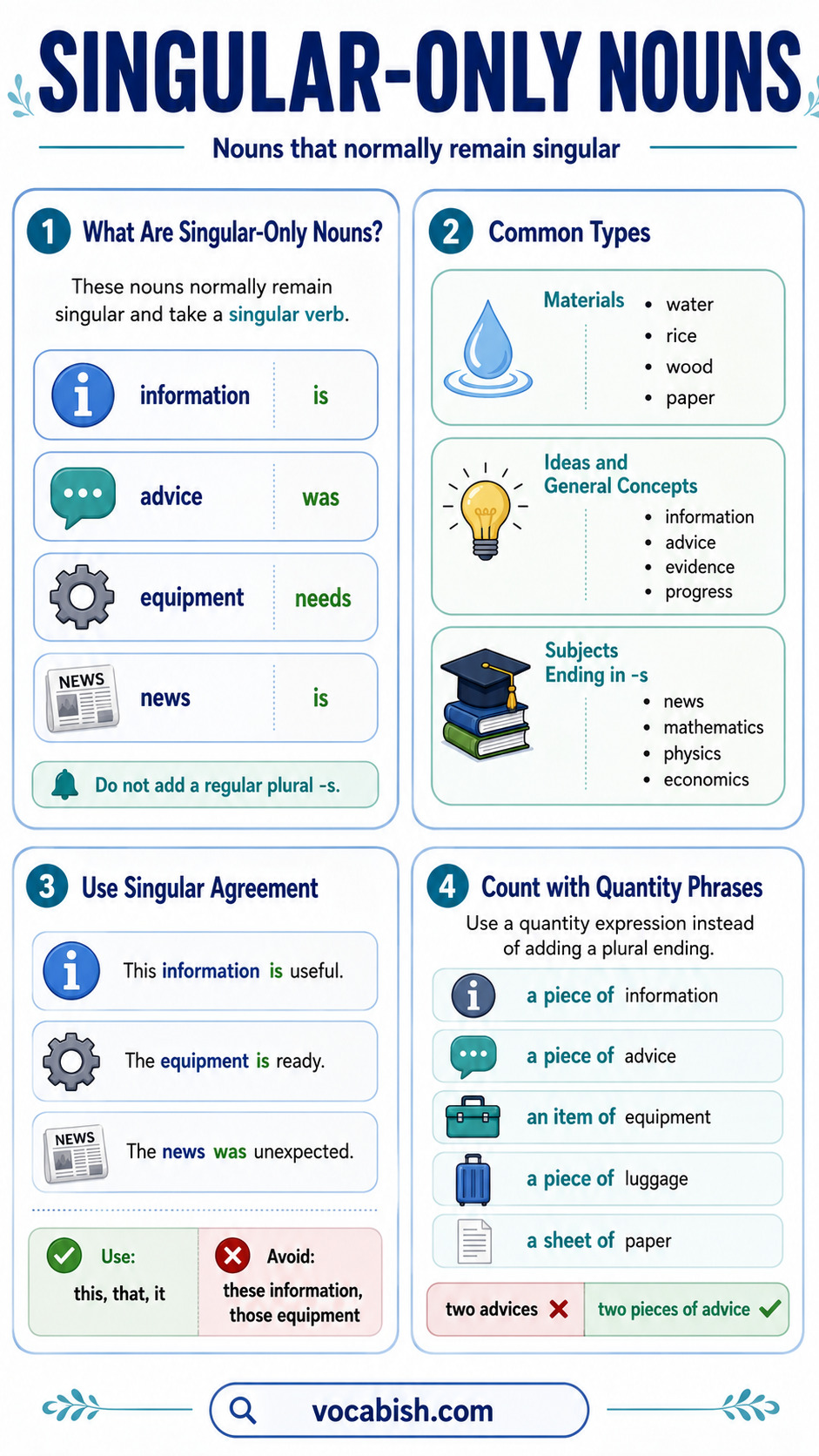
Singular-only nouns are used mainly or entirely in the singular form. They normally:
- take a singular verb
- appear with this, that, or it
- do not take a regular plural -s
- use quantity expressions when an exact number is needed
Singular-only noun | Correct use | Incorrect use |
|---|---|---|
information | The information is accurate. | The informations are accurate. |
advice | Her advice was helpful. | Her advices were helpful. |
equipment | The equipment needs cleaning. | The equipments need cleaning. |
news | The news is encouraging. | The news are encouraging. |
mathematics | Mathematics is difficult for him. | Mathematics are difficult for him. |
The label describes the noun’s normal grammatical behaviour. A few of these nouns may have plural forms in technical, literary, or specialised contexts, but ESL learners should first master their standard everyday use.
Related: Singular and Plural Nouns with Examples
Substance and Material Nouns
Names of substances and materials usually behave as singular nouns when we talk about the material generally.
Common examples include:
- water
- rice
- sugar
- salt
- sand
- steel
- gold
- wood
- glass
- paper
These nouns take singular verbs:
- The water is cold.
- This rice smells fresh.
- The steel has become rusty.
- The paper was damaged.
Do not add -s simply because there is a large amount:
- Incorrect: The sands are hot.
- Correct: The sand is hot.
- Incorrect: These woods are expensive.
- Correct: This wood is expensive.
A plural form may be possible when the meaning changes. For example, woods can mean forested areas, and papers can mean documents or academic articles. In their material meanings, however, wood and paper remain singular.
Read More: Material Nouns Explained in English
Information, Knowledge, and General Concepts
Many nouns describing information, ideas, activities, or general concepts have fixed singular behaviour.
Noun | Example |
|---|---|
information | The information is incomplete. |
knowledge | Her knowledge of history is impressive. |
advice | Your advice has helped me. |
evidence | The evidence supports his claim. |
progress | Our progress is slow but steady. |
research | The research shows a clear pattern. |
homework | My homework is almost finished. |
traffic | The traffic was heavy this morning. |
work | The work requires patience. |
luck | Good luck is not always enough. |
These nouns are not normally used with a, an, or a regular plural ending.
- Incorrect: She gave me an advice.
- Correct: She gave me some advice.
- Incorrect: We found many evidences.
- Correct: We found a great deal of evidence.
- Incorrect: He completed three homeworks.
- Correct: He completed three homework assignments.
The focus here is the noun’s singular grammar. Even when there are several facts, suggestions, or tasks, the general noun may still remain singular.
Singular Nouns Ending in “-s”
Some nouns look plural because they end in -s, but they function as singular nouns.
Common examples include:
- news
- mathematics
- physics
- economics
- linguistics
- ethics
Use a singular verb with these nouns when they name a subject, field, or body of information.
- The news is surprising.
- Mathematics requires regular practice.
- Physics explains how matter and energy behave.
- Economics is taught in this course.
- Linguistics examines how language works.
The final -s is part of the noun. It is not a normal plural ending.
Be careful with words whose agreement changes according to meaning. For example:
- Statistics is an academic subject.
- The statistics are inaccurate.
In the first sentence, statistics means a field of study. In the second, it means numerical figures.
Verb Agreement with Singular-Only Nouns
A singular-only noun normally takes a singular verb, even when the meaning suggests several objects, facts, or activities.
Subject | Correct verb agreement |
|---|---|
The equipment | is ready |
This information | seems reliable |
Her advice | has helped me |
The evidence | supports the argument |
The news | was unexpected |
Mathematics | requires concentration |
Our progress | has been steady |
Compare these sentences:
- The equipment is in the storage room.
- The machines are in the storage room.
- This evidence shows what happened.
- These documents show what happened.
- The news has worried everyone.
- The reports have worried everyone.
Pronouns and determiners should also remain singular:
- This information is useful.
- I received the information, and it was useful.
- That equipment belongs to the school.
Avoid:
- these information
- those equipment
- they were useful, when they refers to the singular noun itself
Related Resources: Noun-Verb Agreement in English
Expressing Quantity Correctly
To count singular-only nouns, use an appropriate quantity expression instead of adding -s.
Singular-only noun | Quantity expression |
|---|---|
information | a piece of information |
advice | a piece of advice |
evidence | a piece of evidence |
equipment | an item of equipment |
furniture | a piece of furniture |
luggage | a piece of luggage |
news | a piece of news |
homework | a homework assignment |
research | a research study |
rice | a grain of rice |
paper | a sheet of paper |
bread | a loaf or slice of bread |
Examples:
- She gave me two pieces of advice.
- We bought three items of equipment.
- The police found several pieces of evidence.
- He carried two pieces of luggage.
- I need one more sheet of paper.
For a general amount, use expressions such as:
- some information
- a little knowledge
- enough equipment
- much progress
- a great deal of research
- plenty of evidence
Common Learner Errors
Common error | Correct form | Reason |
|---|---|---|
The information are correct. | The information is correct. | Information takes a singular verb. |
She gave me an advice. | She gave me some advice. | Advice does not normally take a/an. |
We bought new equipments. | We bought new equipment. | Equipment has no regular plural form. |
These evidence are useful. | This evidence is useful. | Evidence takes singular agreement. |
The news were shocking. | The news was shocking. | News is grammatically singular. |
Mathematics are difficult. | Mathematics is difficult. | The subject name takes a singular verb. |
I made many progresses. | I made a lot of progress. | Progress normally remains singular. |
He completed two homeworks. | He completed two homework assignments. | Count the assignments, not homework itself. |
A useful editing check is to ask three questions:
- Have I added an unnecessary plural -s?
- Does the noun need a singular verb?
- Do I need a quantity phrase instead of a number directly before the noun?
Practice Exercise
Choose the correct answer.
- The news is / are better than we expected.
- This equipment needs / need regular maintenance.
- She gave me two advices / pieces of advice.
- Mathematics is / are his strongest subject.
- We received some useful information / informations.
- The evidence supports / support the conclusion.
- They carried three luggages / pieces of luggage.
- Physics requires / require careful observation.
- The team has made much progress / many progresses.
- Choose the correct sentence:
a. These research are valuable.
b. This research is valuable.
Answers
- is
- needs
- pieces of advice
- is
- information
- supports
- pieces of luggage
- requires
- much progress
- This research is valuable.
FAQs About Singular Only Nouns
Singular-only nouns are nouns that normally take singular verbs and do not form regular plurals when used in their usual meaning.
Use a singular verb because the noun is grammatically singular: The information is useful, not The information are useful in standard English.
No. Many are uncountable, but some singular-only nouns are fixed singular terms, especially subject names such as mathematics and physics.
Use a quantity phrase such as a piece of advice, an item of equipment, or a useful bit of information.
News ends in -s, but it functions as a singular noun, so we say The news is surprising to everyone.
Usually not in their ordinary meaning. Some may have plural forms only when they refer to types, varieties, or separate instances.
Remember the noun’s standard grammatical pattern, then check verb agreement and use a suitable quantity expression instead of adding -s.
Short Summary
- Singular-only nouns normally remain singular.
- They usually take singular verbs.
- Some end in -s but are not plural.
- Do not add a regular plural ending to nouns such as information, advice, or equipment.
- Use quantity phrases such as a piece of, an item of, or a sheet of when counting.
- Check the noun’s meaning because a few words can become plural in specialised uses.
You May Also Like