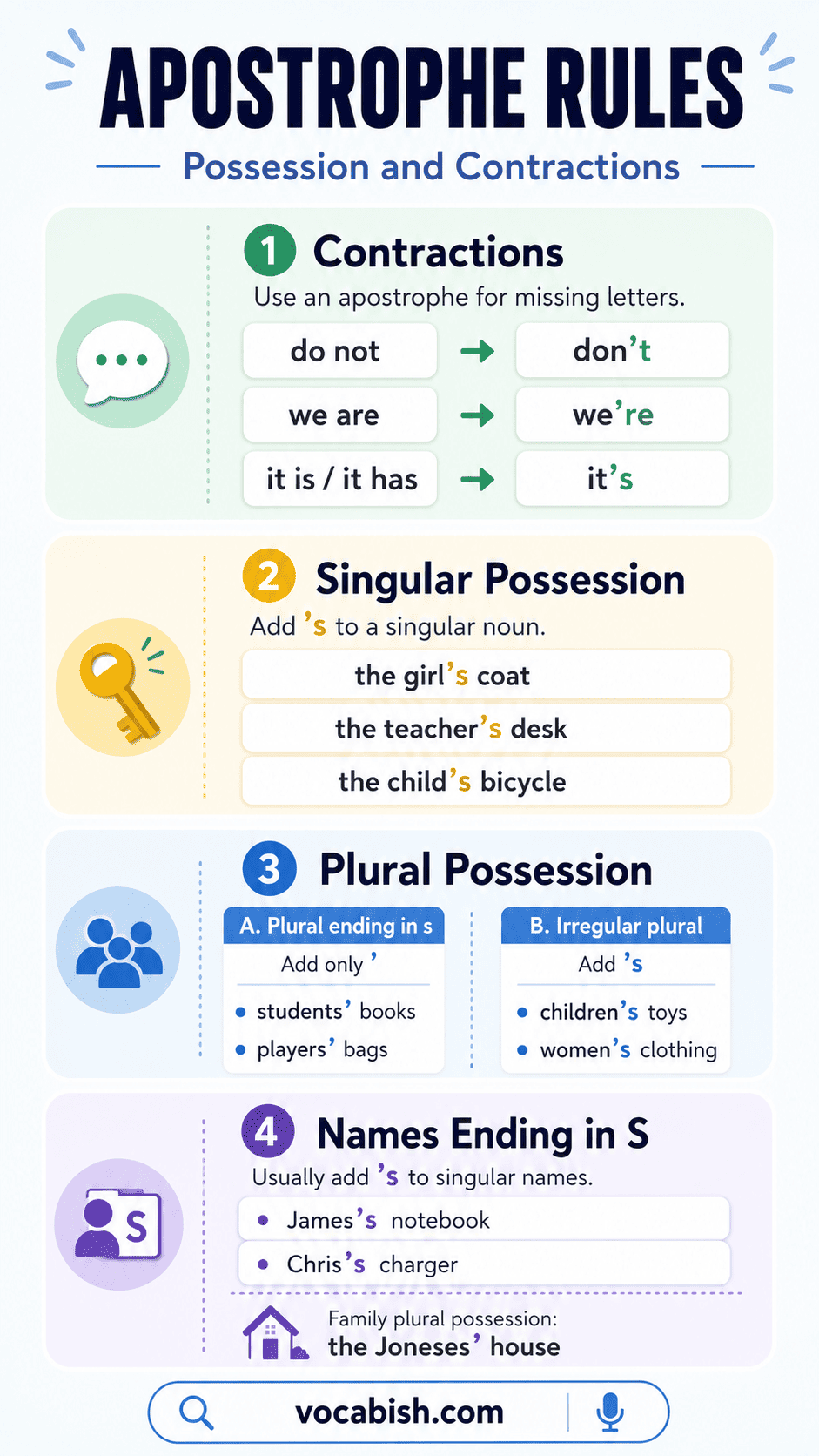

An apostrophe (’) is a small punctuation mark with two main jobs: it shows missing letters in contractions and indicates possession. Although the mark is simple, its position can completely change the meaning of a phrase.
Learning the main apostrophe rules will help you avoid common errors such as apple’s, its’, and the childrens’ room.
Apostrophes in Contractions
A contraction joins two words and leaves out one or more letters. The apostrophe appears where the missing letters were removed.
Full Form | Contraction | Missing Letters |
|---|---|---|
do not | don’t | o |
cannot | can’t | no |
I am | I’m | a |
we are | we’re | a |
they have | they’ve | ha |
she will | she’ll | wi |
let us | let’s | u |
will not | won’t | irregular form |
Examples:
- I don’t understand the question.
- We’re meeting after class.
- Maria hasn’t finished her homework.
- Let’s practise these sentences again.
- You shouldn’t touch that wire.
Some contractions can represent more than one full form:
Contraction | Possible Meanings | Examples |
|---|---|---|
she’s | she is / she has | She’s tired. / She’s finished. |
he’d | he had / he would | He’d left. / He’d help. |
it’s | it is / it has | It’s cold. / It’s been difficult. |
who’s | who is / who has | Who’s calling? / Who’s taken it? |
The surrounding words usually make the meaning clear.
Contractions and Formal Writing
Contractions are natural in:
- everyday conversation
- informal emails
- personal messages
- dialogue
- friendly articles
Full forms may be more suitable in:
- formal reports
- academic assignments
- official notices
- legal documents
Compare:
- Informal: We can’t approve the request today.
- Formal: We cannot approve the request today.
Singular Possessive Nouns
A possessive noun shows that something belongs to or is connected with someone or something.
Add ’s to a singular noun:
Singular Noun | Possessive Form | Example |
|---|---|---|
student | student’s | the student’s notebook |
teacher | teacher’s | the teacher’s desk |
dog | dog’s | the dog’s collar |
company | company’s | the company’s policy |
child | child’s | the child’s bicycle |
Sentence examples:
- The girl’s coat is hanging by the door.
- We visited the doctor’s office.
- The book’s cover was damaged.
- My brother’s phone is missing.
- The school’s entrance closes at six.
The possessed object does not always need to appear:
- This bag is Amina’s.
- We are having dinner at Ahmed’s.
- That seat is my sister’s.
Possession Is Not Always Ownership
An apostrophe can show several kinds of relationships:
- the manager’s decision — a decision made by the manager
- today’s lesson — the lesson for today
- Pakistan’s population — the population of Pakistan
- the car’s engine — the engine that is part of the car
- two weeks’ notice — a notice period lasting two weeks
Plural Possessive Nouns
The apostrophe position depends on how the plural noun is formed.
Regular Plurals Ending in “S”
Add only an apostrophe after the final s:
Plural Noun | Possessive Form | Example |
|---|---|---|
students | students’ | the students’ projects |
teachers | teachers’ | the teachers’ lounge |
players | players’ | the players’ uniforms |
dogs | dogs’ | the dogs’ bowls |
neighbours | neighbours’ | the neighbours’ garden |
Examples:
- The students’ results were announced today.
- Both players’ bags were in the changing room.
- The workers’ uniforms need replacing.
- We listened to the teachers’ suggestions.
Irregular Plurals Not Ending in “S”
Add ’s:
Irregular Plural | Possessive Form | Example |
|---|---|---|
children | children’s | children’s books |
men | men’s | men’s shoes |
women | women’s | women’s clothing |
people | people’s | people’s opinions |
mice | mice’s | mice’s nests |
Examples:
- The children’s playground is being repaired.
- We discussed people’s concerns.
- The shop sells women’s jackets.
- The men’s changing room is downstairs.
Singular and Plural Possession Compared
Form | Meaning |
|---|---|
the teacher’s room | the room of one teacher |
the teachers’ room | the room of several teachers |
the girl’s bags | several bags belonging to one girl |
the girls’ bags | bags belonging to several girls |
the child’s toys | toys belonging to one child |
the children’s toys | toys belonging to several children |
The apostrophe’s position tells the reader whether the owner is singular or plural.
Names Ending in “S”
Most modern writing styles add ’s to a singular name ending in s:
- James’s laptop
- Chris’s bicycle
- Carlos’s passport
- Iris’s garden
- Thomas’s opinion
Examples:
- James’s presentation begins at ten.
- I borrowed Chris’s charger.
- We visited Thomas’s house yesterday.
Some style guides permit only an apostrophe after certain names:
- James’ laptop
- Charles’ speech
- Jesus’ teachings
Both patterns appear in published English. For general writing, James’s is widely accepted and often easier for learners to apply consistently.
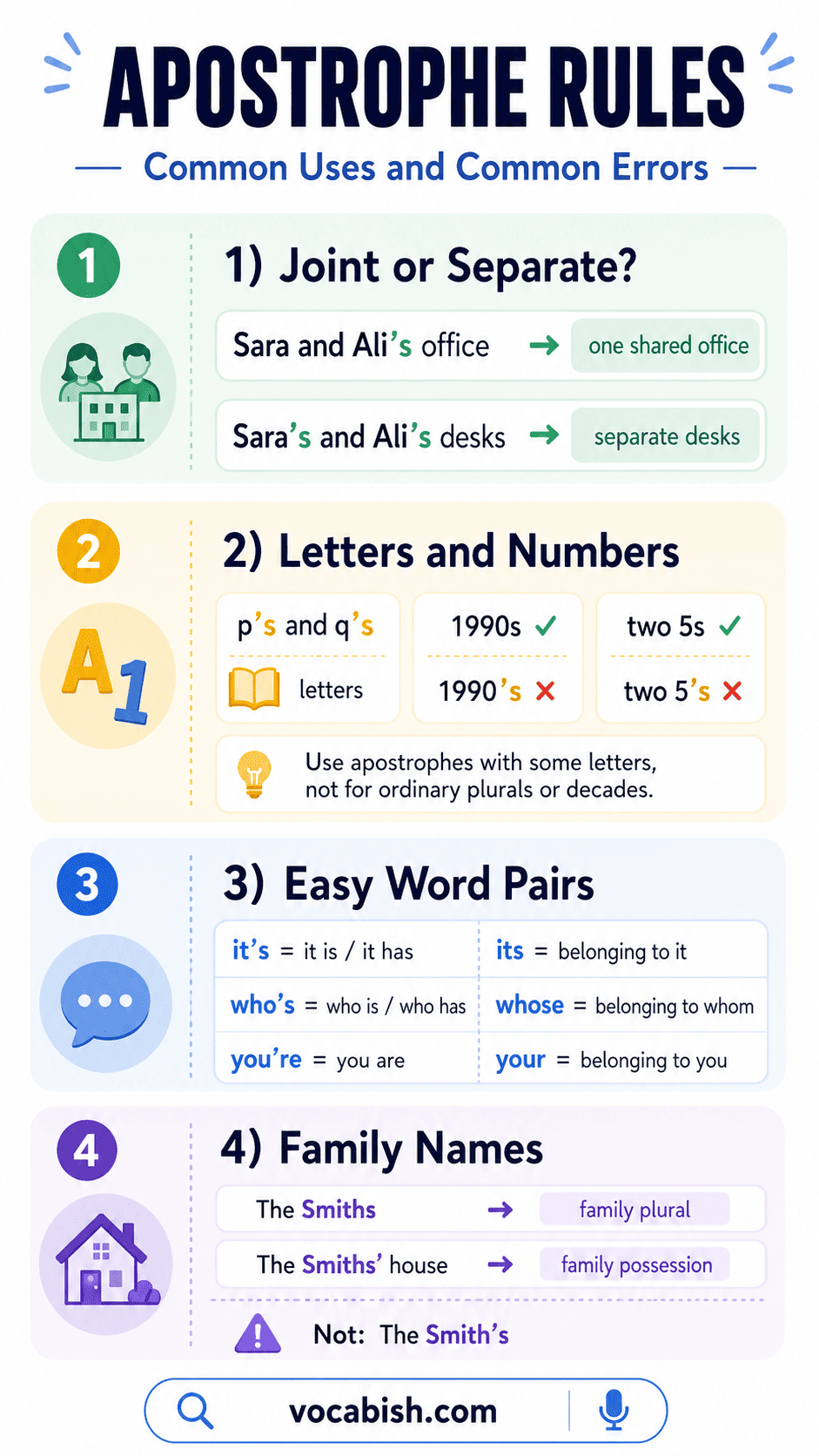
For plural family names ending in s, place the apostrophe after the plural form:
- the Williamses’ house
- the Joneses’ car
- the Harrises’ garden
Compare:
Form | Meaning |
|---|---|
Mr Jones’s office | the office of Mr Jones |
the Joneses’ office | the office belonging to the Jones family |
Joint and Separate Possession
When two people share one item, add ’s only to the final name.
Joint Possession
- Ayesha and Hamza’s house
- Bilal and Ahmed’s business
- Sara and Ali’s wedding
- Jack and Emma’s project
Examples:
- We visited Ayesha and Hamza’s house.
- Sara and Ali’s wedding is in October.
- I reviewed Jack and Emma’s project.
The house, wedding, or project belongs to both people together.
Separate Possession
When each person owns a separate item, make both names possessive:
- Ayesha’s and Hamza’s cars
- Bilal’s and Ahmed’s businesses
- Sara’s and Ali’s offices
- Jack’s and Emma’s projects
Compare:
Phrase | Meaning |
|---|---|
Nadia and Mariam’s apartment | They share one apartment. |
Nadia’s and Mariam’s apartments | Each person has an apartment. |
Ali and Omar’s manager | They have the same manager. |
Ali’s and Omar’s managers | They have different managers. |
Apostrophes with Letters and Numbers
Apostrophes are sometimes used with letters for clarity, but they are not normally used to form plurals of numbers, abbreviations, or decades.
Lowercase Letters
Use apostrophes when plural lowercase letters might be difficult to read:
- Dot your i’s and cross your t’s.
- Mind your p’s and q’s.
- The word contains three e’s.
Without apostrophes, forms such as is and as could look like ordinary words.
Capital Letters
Capital letters usually take a simple s:
- She received three As.
- The sign contains two Rs.
- Remember to write your IDs clearly.
Some styles use apostrophes for extra clarity, but plain plurals are now common.
Numbers and Decades
Do not use an apostrophe to make a number plural:
Correct | Incorrect |
|---|---|
two 5s | two 5’s |
three 7s | three 7’s |
the 1990s | the 1990’s |
people in their 20s | people in their 20’s |
Use an apostrophe when numbers are omitted:
- the ’90s = the 1990s
- the class of ’26 = the class of 2026
Use a possessive apostrophe when the number expression shows possession:
- the 1990s’ fashion trends
- the team of 2026’s achievement
The first example refers to trends belonging to the entire decade.