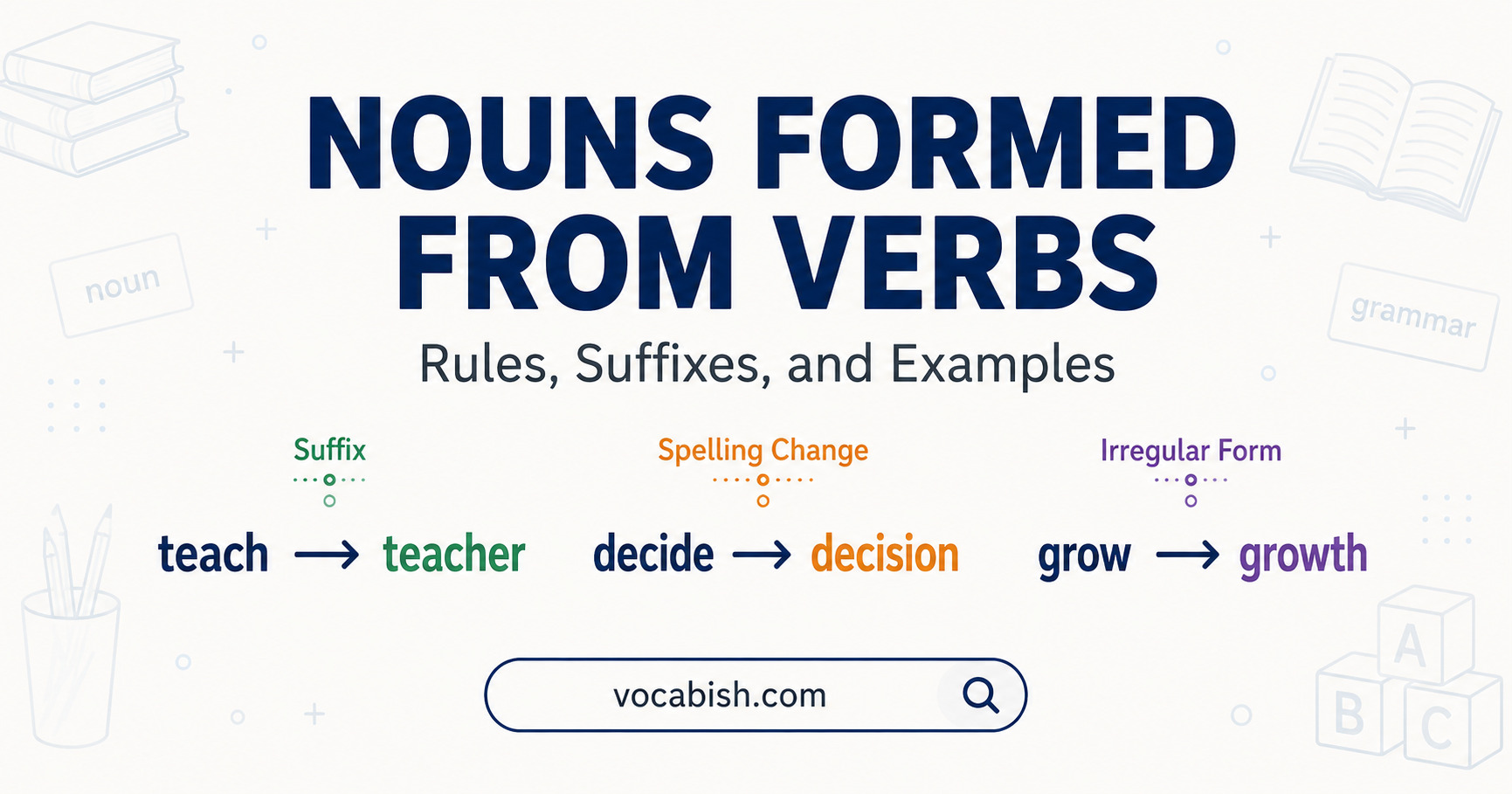

Nouns formed from verbs are words created from verbs to name people, actions, processes, states, or results. For example, “teach” becomes “teacher,” while “decide” becomes “decision.”
English uses suffixes, spelling changes, irregular forms, and unchanged word forms to create these nouns. Learning the common patterns makes vocabulary building easier.
How Verbs Change into Nouns
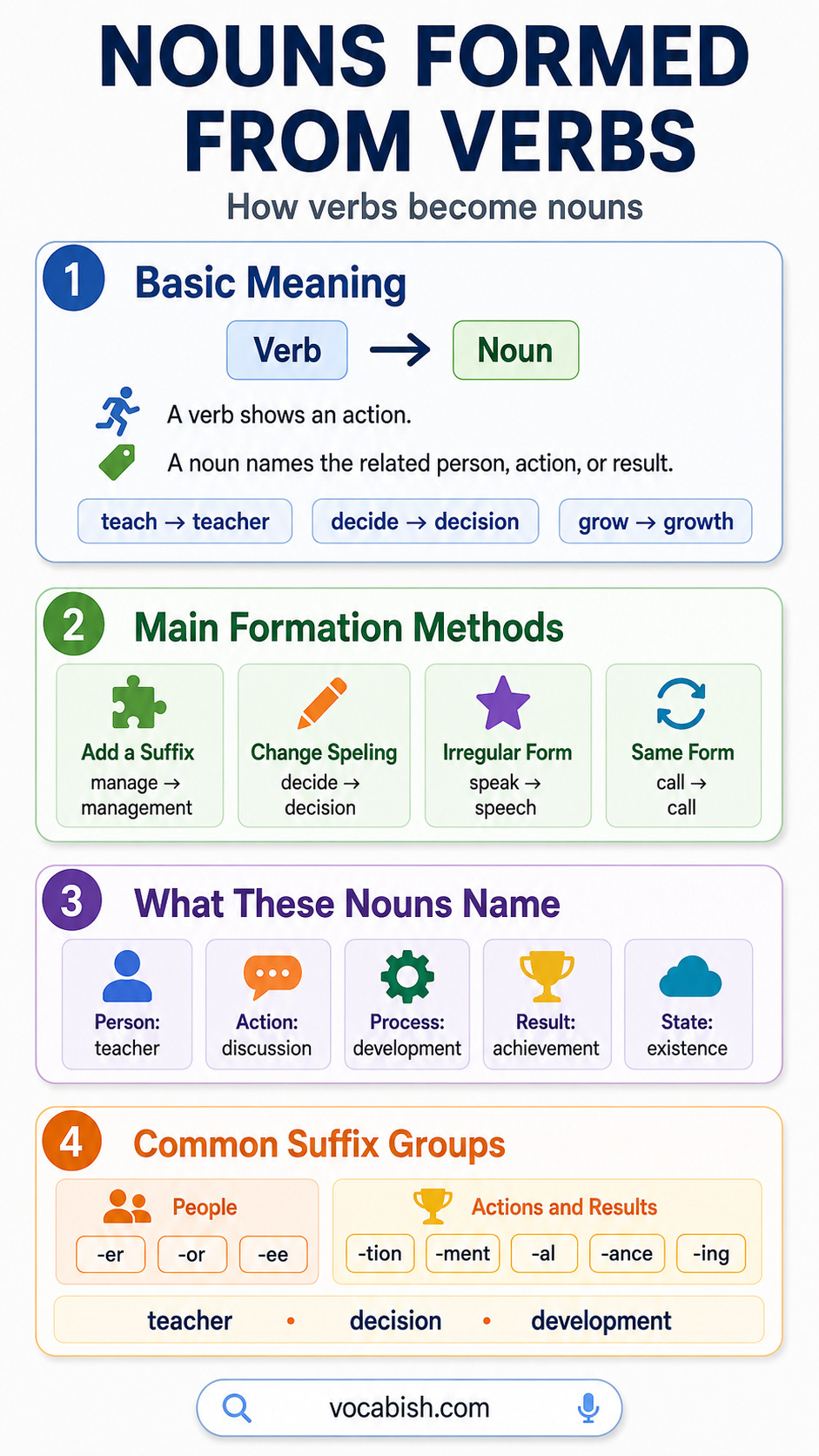
A verb describes an action or state. Its noun form names the person, action, process, or result connected with that verb.
- teach → teacher
- develop → development
- arrive → arrival
- choose → choice
- call → call
The main formation methods are:
- Adding a suffix: manage → management
- Changing the spelling: decide → decision
- Using an irregular form: grow → growth
- Using the same word: answer → answer
Types of Nouns Formed from Verbs
Nouns formed from verbs can name people, actions, processes, states, or results.
Type | What It Names | Verb | Noun |
|---|---|---|---|
Person | Someone who performs an action | teach | teacher |
Receiver | Someone who receives an action | employ | employee |
Action | Something that someone does | discuss | discussion |
Process | An activity or gradual change | develop | development |
Result | The outcome of an action | achieve | achievement |
State | A condition or situation | exist | existence |
Some verbs can produce more than one noun:
Verb | Person Noun | Action or Result Noun |
|---|---|---|
employ | employer, employee | employment |
educate | educator | education |
invent | inventor | invention |
perform | performer | performance |
translate | translator | translation |
Common Verb-to-Noun Suffixes
A suffix is an ending added to a verb to create a noun.
Suffix | Common Meaning | Examples |
|---|---|---|
-er | Person or thing performing an action | teach → teacher print → printer |
-or | Person performing an action | act → actor direct → director |
-ee | Person receiving an action | employ → employee train → trainee |
-tion / -sion | Action, process, or result | inform → information decide → decision |
-ment | Action, process, or result | develop → development improve → improvement |
-al | Action or event | arrive → arrival refuse → refusal |
-ance / -ence | Action, state, or condition | perform → performance exist → existence |
-ure | Action or result | fail → failure depart → departure |
-ing | Activity or process | swim → swimming read → reading |
A suffix cannot be added freely to every verb. English normally uses established word forms rather than one rule for all verbs.
Irregular Verb-to-Noun Forms
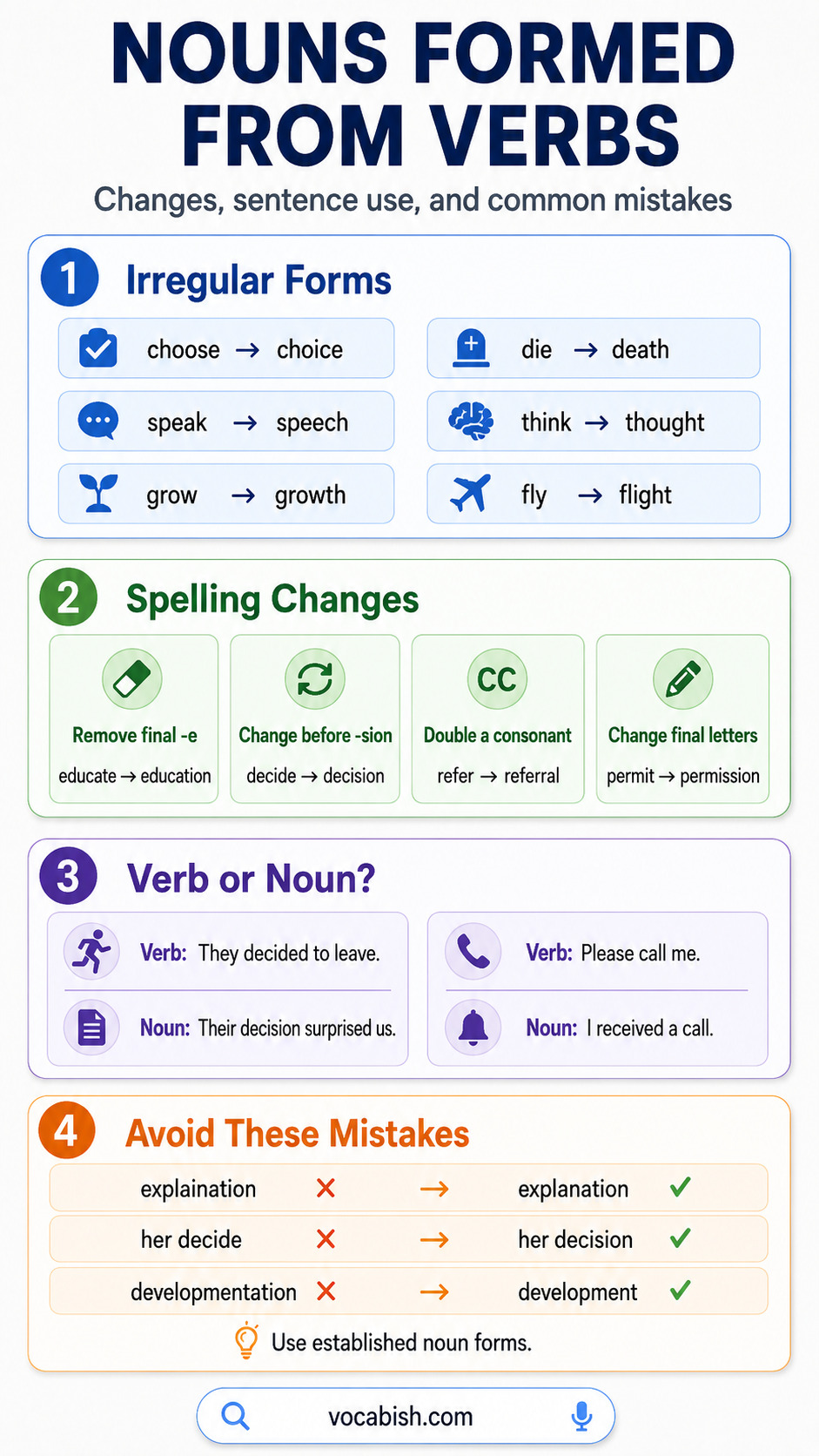
Some nouns are formed through larger spelling or sound changes.
Verb | Noun |
|---|---|
choose | choice |
speak | speech |
grow | growth |
lose | loss |
die | death |
think | thought |
believe | belief |
live | life |
fly | flight |
sell | sale |
These forms are best learned as vocabulary pairs because they do not follow one regular pattern.
Spelling Changes
Adding a noun suffix may change the spelling of the original verb.
Spelling Pattern | Verb | Noun |
|---|---|---|
Final e is removed | educate | education |
de changes before -sion | decide | decision |
Final letters change | permit | permission |
Final y changes to i | satisfy | satisfaction |
Consonant may double | refer | referral |
Pronunciation and spelling change | describe | description |
Notice these common patterns:
- decide → decision
- admit → admission
- expand → expansion
- apply → application
- refuse → refusal
- occur → occurrence
Spelling patterns can help, but checking a dictionary is safer when the noun form is unfamiliar.
Verb and Noun Forms in Sentences
The verb usually follows a subject and shows an action. The noun can act as a subject, object, or complement.
Verb Sentence | Noun Sentence |
|---|---|
They decided to leave. | Their decision surprised us. |
The company employs 200 people. | Employment has increased. |
She performed confidently. | Her performance was impressive. |
We discussed the problem. | The discussion lasted an hour. |
The city developed rapidly. | The development changed the area. |
He answered politely. | His answer was polite. |
Some words have identical verb and noun forms:
- Verb: Please call me tonight.
- Noun: I received a call tonight.
- Verb: We visited the museum.
- Noun: Our visit lasted two hours.
- Verb: She replied immediately.
- Noun: Her reply was helpful.
You May Also Like: Nouns That Are Always Singular or Plural
Examples of Nouns Formed from Verbs
No. | Verb | Noun | Suffix Used |
|---|---|---|---|
1 | teach | teacher | -er |
2 | write | writer | -er |
3 | sing | singer | -er |
4 | manage | manager | -er |
5 | act | actor | -or |
6 | direct | director | -or |
7 | visit | visitor | -or |
8 | employ | employee | -ee |
9 | train | trainee | -ee |
10 | develop | development | -ment |
11 | improve | improvement | -ment |
12 | agree | agreement | -ment |
13 | achieve | achievement | -ment |
14 | decide | decision | -sion |
15 | expand | expansion | -sion |
16 | revise | revision | -sion |
17 | inform | information | -ation |
18 | translate | translation | -ion |
19 | construct | construction | -ion |
20 | invent | invention | -ion |
21 | arrive | arrival | -al |
22 | approve | approval | -al |
23 | refuse | refusal | -al |
24 | perform | performance | -ance |
25 | appear | appearance | -ance |
26 | exist | existence | -ence |
27 | fail | failure | -ure |
28 | depart | departure | -ure |
29 | read | reading | -ing |
30 | swim | swimming | -ing |
Common Formation Mistakes
- Do not add -tion to every verb.
Incorrect: explaination
Correct: explanation - Do not confuse a person noun with an action noun.
Teacher names a person; teaching names an activity. - Avoid using a verb where a noun is required.
Incorrect: Her decide was unexpected.
Correct: Her decision was unexpected. - Check irregular forms carefully.
Incorrect: choosing when the required noun is choice - Do not use two noun endings together.
Incorrect: developmentation
Correct: development - Remember that related nouns may have different meanings.
Employment means having work, while employee means a worker.
Practice Exercise
Complete each sentence with the correct noun form of the verb in brackets.
- The manager gave his final __________. (approve)
- Her sudden __________ surprised everyone. (arrive)
- The company plans further __________ next year. (expand)
- The doctor explained the treatment clearly, but his __________ was brief. (explain)
- The actor gave an excellent __________. (perform)
- We are waiting for your __________. (decide)
- The bridge is still under __________. (construct)
- His strong __________ helped him recover. (believe)
- The shop reported an increase in __________. (sell)
- Regular __________ can improve your health. (swim)
Answers:
- approval
- arrival
- expansion
- explanation
- performance
- decision
- construction
- belief
- sales
- swimming
FAQs
They are nouns created from verbs to name a person, action, process, event, state, or result connected with the original verb.
Common endings include -er, -or, -tion, -ment, -al, -ance, -ence, -ure, and -ing, although their use depends on the individual verb.
Yes. Some words use the same form as verbs and nouns, such as call, reply, visit, walk, and answer in English.
Spelling changes happen because suffixes affect the verb’s final letters, pronunciation, or stress, as in decide–decision and permit–permission in standard English word formation.
No. Some are irregular, such as speak–speech and choose–choice, while others use conversion without adding an ending to the original verb.
Check whether the word names a person, thing, action, state, process, or result and can function as a subject or object.
No. Verb-to-noun patterns are not fully predictable, so learners should check a reliable dictionary and study each noun with its verb.
Short Summary
Nouns formed from verbs name people, actions, processes, states, and results. They may use suffixes, irregular changes, spelling changes, or the unchanged verb form. Common patterns are helpful, but unfamiliar forms should always be checked in a reliable dictionary.
You May Also Like