
A noun does more than name a person, place, object, or idea. Inside a sentence, it performs a specific job. It may tell us who acts, who receives something, what someone becomes, or what follows a preposition.
These sentence jobs are called the functions of nouns. Recognising them helps learners understand sentence structure and use nouns accurately.
Nouns as Subjects
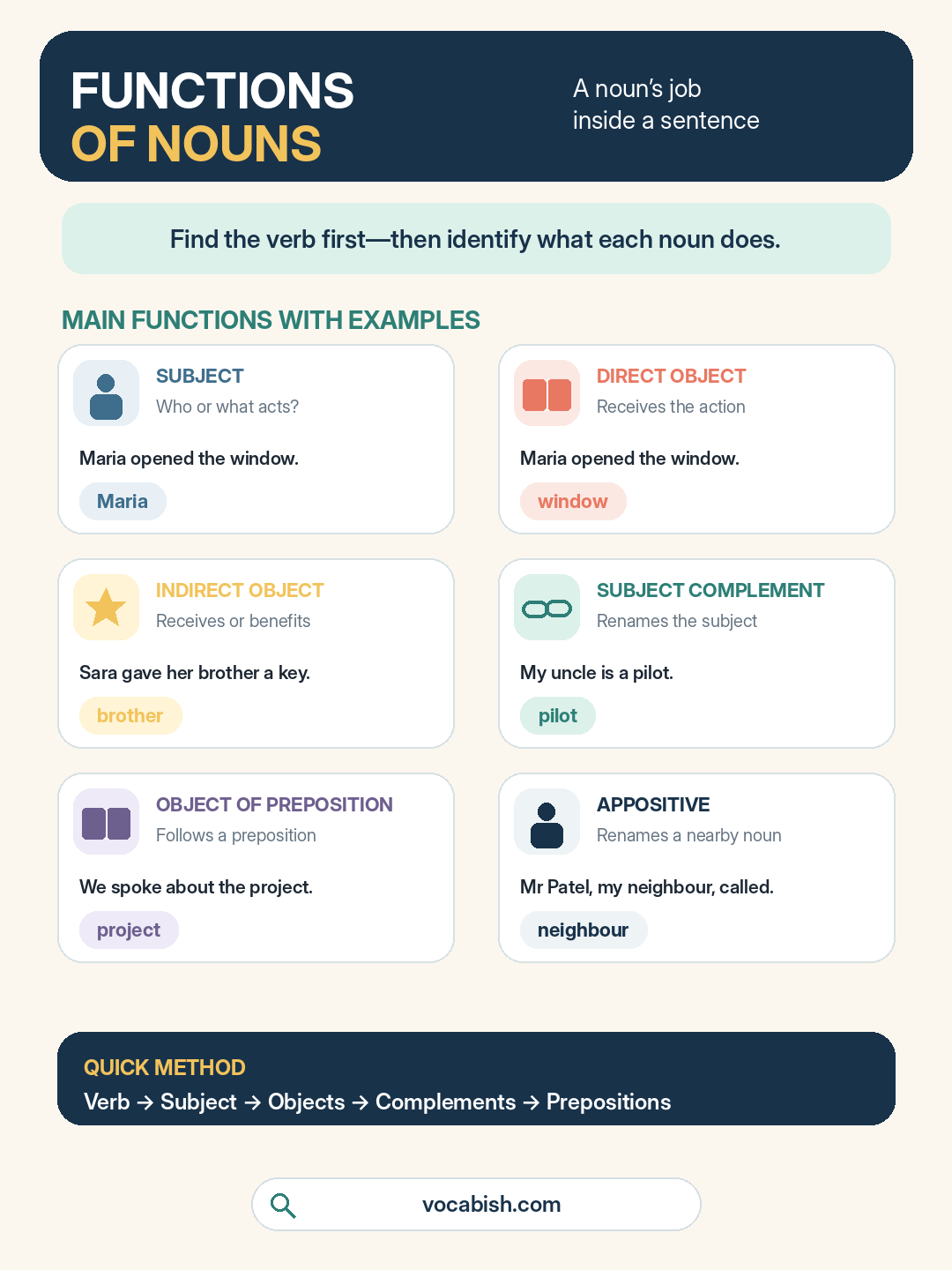
The subject tells us who or what the sentence is about. It usually performs the action or experiences the condition expressed by the verb.
- Maria opened the window.
- The children are playing outside.
- Rain continued throughout the night.
- Patience takes practice.
In each sentence, the bold noun or noun phrase controls the main verb.
A subject may appear after the verb in questions or sentences beginning with there:
- Where is Daniel?
- There are two books on the desk.
To find the subject, identify the verb and ask:
- Who performs the action?
- What experiences the condition?
- Who or what is being described?
Nouns as Direct and Indirect Objects
Objects usually appear after action verbs. They receive the action or show who benefits from it.
Noun function | Purpose | Example |
|---|---|---|
Direct object | Receives the action directly | Sara cleaned the kitchen. |
Indirect object | Receives the direct object or benefits from the action | Sara gave her brother a key. |
Direct Objects
A direct object answers what? or whom? after the verb.
- Leo repaired the bicycle.
- We watched the match.
- The manager thanked Aisha.
Ask:
- Leo repaired what? — the bicycle
- The manager thanked whom? — Aisha
Not every action verb requires a direct object:
- The baby laughed.
- Everyone arrived.
These sentences are complete without objects.
Indirect Objects
An indirect object usually answers:
- To whom?
- For whom?
- To what?
It normally comes before the direct object.
- Emma sent her friend a postcard.
- The teacher gave the class homework.
- Dad cooked us dinner.
In “Emma sent her friend a postcard”:
- her friend = indirect object
- a postcard = direct object
The same idea can often be expressed with to or for:
- Emma sent a postcard to her friend.
- Dad cooked dinner for us.
In these versions, friend and us are objects of prepositions rather than indirect objects.
Nouns as Complements
A complement completes the meaning of another sentence element. A noun can work as a subject complement or an object complement.
Complement | What it does | Example |
|---|---|---|
Subject complement | Renames or identifies the subject | Elena is an architect. |
Object complement | Renames or identifies the direct object | They elected Marcus captain. |
Subject Complements
A noun used as a subject complement follows a linking verb and identifies the subject.
Common linking verbs include:
- be
- become
- remain
- seem
Examples:
- My uncle is a pilot.
- Nina became the team leader.
- His greatest concern was time.
The noun complement refers to the same person or thing as the subject:
- uncle = pilot
- Nina = team leader
- concern = time
Object Complements
An object complement follows a direct object and gives it another name or identity.
- We named the puppy Luna.
- The committee appointed Maya chairperson.
- Everyone considered Mr Khan a reliable leader.
In “We named the puppy Luna”:
- the puppy = direct object
- Luna = object complement
The puppy and Luna refer to the same animal.
You May Also Like: Noun Clauses Explained with Types and Examples
Nouns after Prepositions
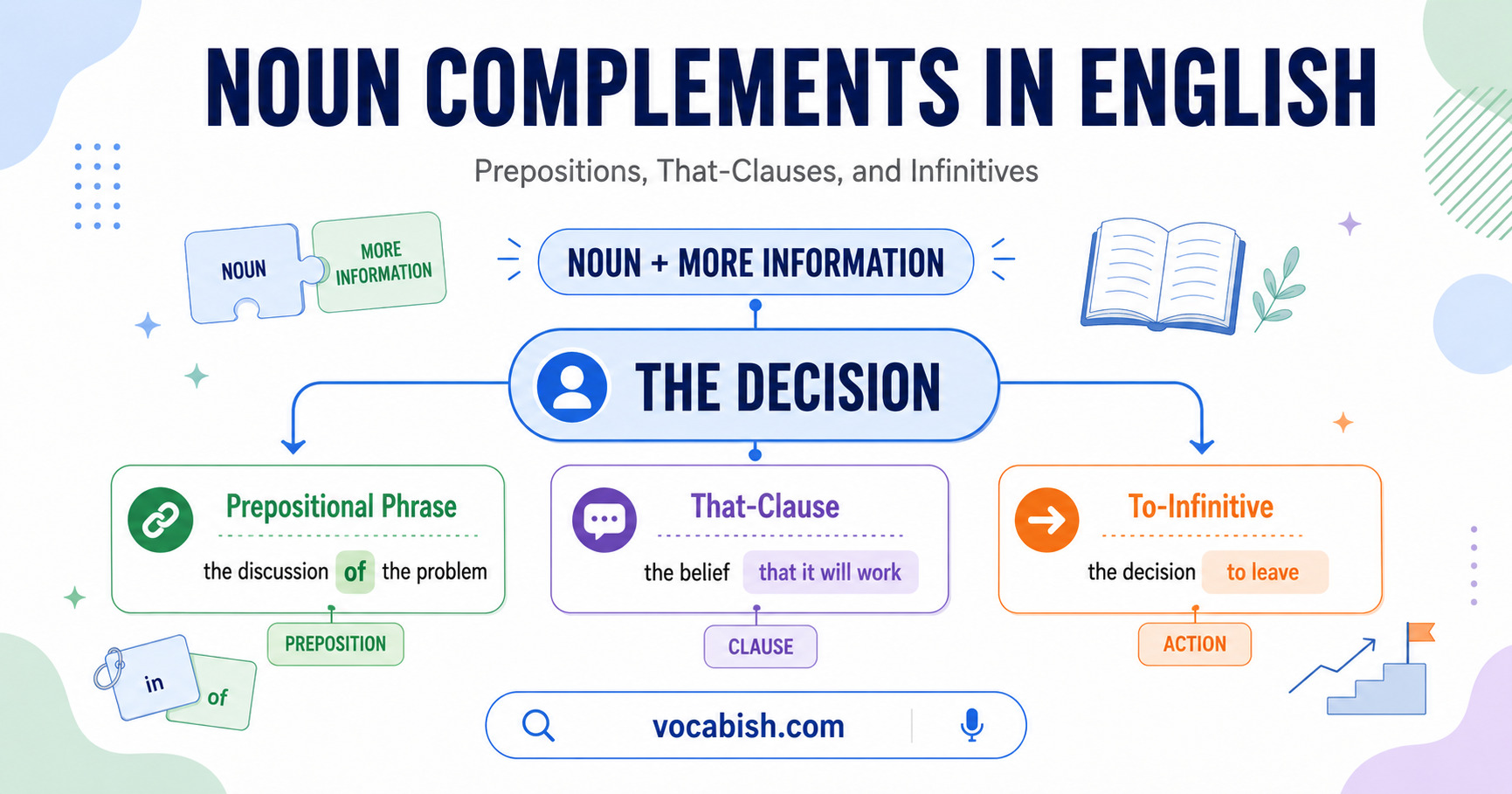
A noun that follows a preposition is called the object of the preposition.
- The keys are under the sofa.
- We spoke about the project.
- She travelled with her sister.
- They arrived after lunch.
Common prepositions include:
- at
- by
- for
- from
- in
- near
- of
- on
- to
- with
The preposition and its object form a prepositional phrase:
Prepositional phrase | Preposition | Noun object |
|---|---|---|
beside the river | beside | river |
during the meeting | during | meeting |
without permission | without | permission |
for my parents | for | parents |
A noun inside a prepositional phrase does not usually function as the sentence’s subject or direct object.
- The colour of the walls looks brighter.
The complete subject is the colour of the walls, but the main subject noun is colour. The noun walls is the object of of.
Nouns in Apposition
A noun in apposition, called an appositive, stands beside another noun and renames or explains it.
- My neighbour, Mr Patel, owns the bakery.
- A talented musician, Sofia performs every weekend.
- Their dog Bruno loves swimming.
- Islamabad, the capital of Pakistan, has many green spaces.
An appositive may be essential or additional.
Type | Use | Example |
|---|---|---|
Essential appositive | Identifies exactly which person or thing is meant | My friend Hassan called me. |
Non-essential appositive | Adds extra information | Hassan, my oldest friend, called me. |
Non-essential appositives are separated with commas. Essential appositives are not.
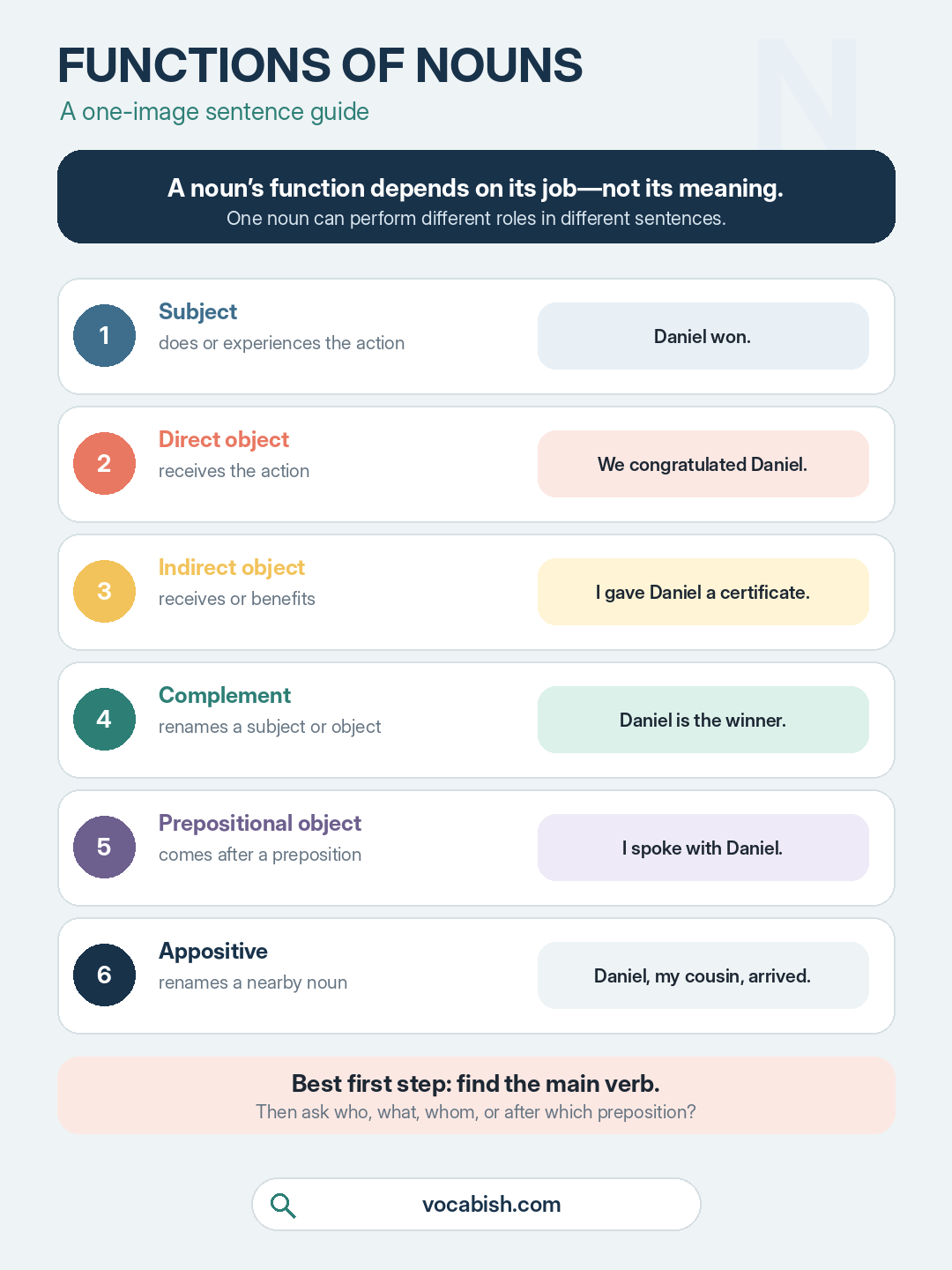
Identifying Noun Functions
Use this order when analysing a sentence:
- Find the main verb.
- Find the subject by asking who or what performs the action or is described.
- Check for objects after an action verb.
- Look for complements after linking verbs or direct objects.
- Notice prepositions and identify the nouns that complete them.
- Check for appositives that rename nearby nouns.
Compare these examples:
Sentence | Noun | Function |
|---|---|---|
Noah wrote a message. | Noah | Subject |
Noah wrote a message. | message | Direct object |
Noah sent Mia a message. | Mia | Indirect object |
Noah is a writer. | writer | Subject complement |
They called Noah a writer. | writer | Object complement |
The message came from Noah. | Noah | Object of a preposition |
Noah, my cousin, wrote the message. | cousin | Appositive |
The same noun can perform different functions in different sentences:
- Daniel won the competition. — subject
- We congratulated Daniel. — direct object
- I gave Daniel the certificate. — indirect object
- The winner was Daniel. — subject complement
- I spoke with Daniel. — object of a preposition
Sentence Analysis Practice
Identify the function of each bold noun or noun phrase.
- The new student answered confidently.
- Mia bought a notebook.
- The guide showed the tourists the castle.
- My sister is a pharmacist.
- The team chose Ahmed captain.
- We waited near the entrance.
- Our teacher, Mrs Lewis, organised the event.
- The storm damaged several houses.
Answers
Number | Correct function |
|---|---|
1 | Subject |
2 | Direct object |
3 | Indirect object |
4 | Subject complement |
5 | Object complement |
6 | Object of a preposition |
7 | Appositive |
8 | Direct object |
FAQs About Functions of Nouns
Nouns commonly function as subjects, direct objects, indirect objects, subject complements, object complements, objects of prepositions, and appositives in sentences.
Find the verb first. The subject performs or experiences the action, while the object receives the action or completes the verb’s meaning.
No single noun normally performs both roles at once, but a sentence may contain one noun as subject and another as complement.
A direct object receives the action, while an indirect object identifies the person or thing that receives the direct object or benefits from the action.
They are called objects because they complete the meaning of the preposition and form a prepositional phrase with it in the sentence.
An appositive usually appears beside the noun it renames, although longer appositive phrases may include modifiers between their main words.
Yes. Pronouns can serve as subjects, objects, complements, and objects of prepositions because they replace nouns or noun phrases in sentences.
Short Summary
The function of a noun depends on its job in a sentence. A noun may act as a subject, object, complement, prepositional object, or appositive. Finding the verb first makes these functions easier to identify.
You May Also Like