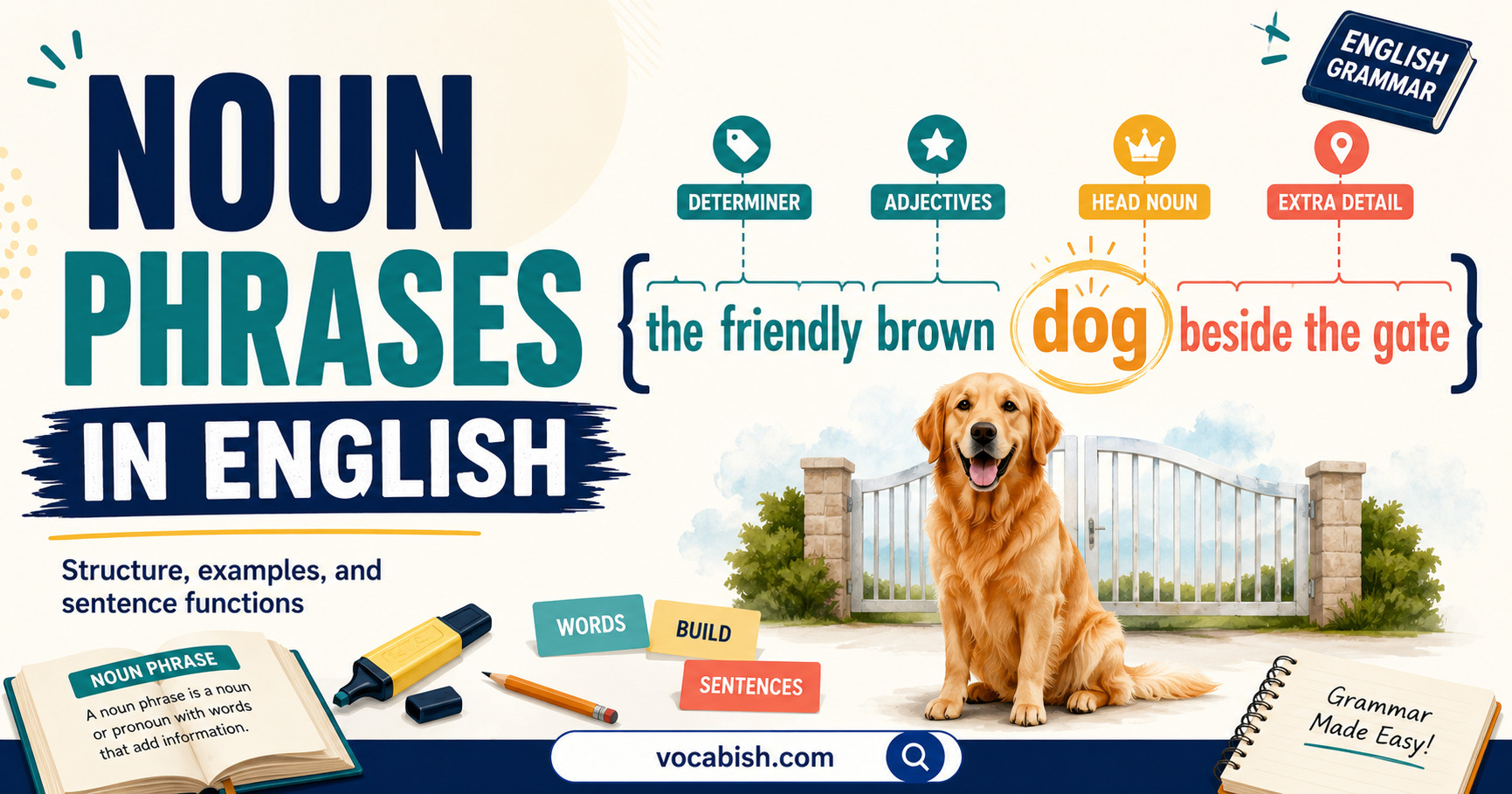

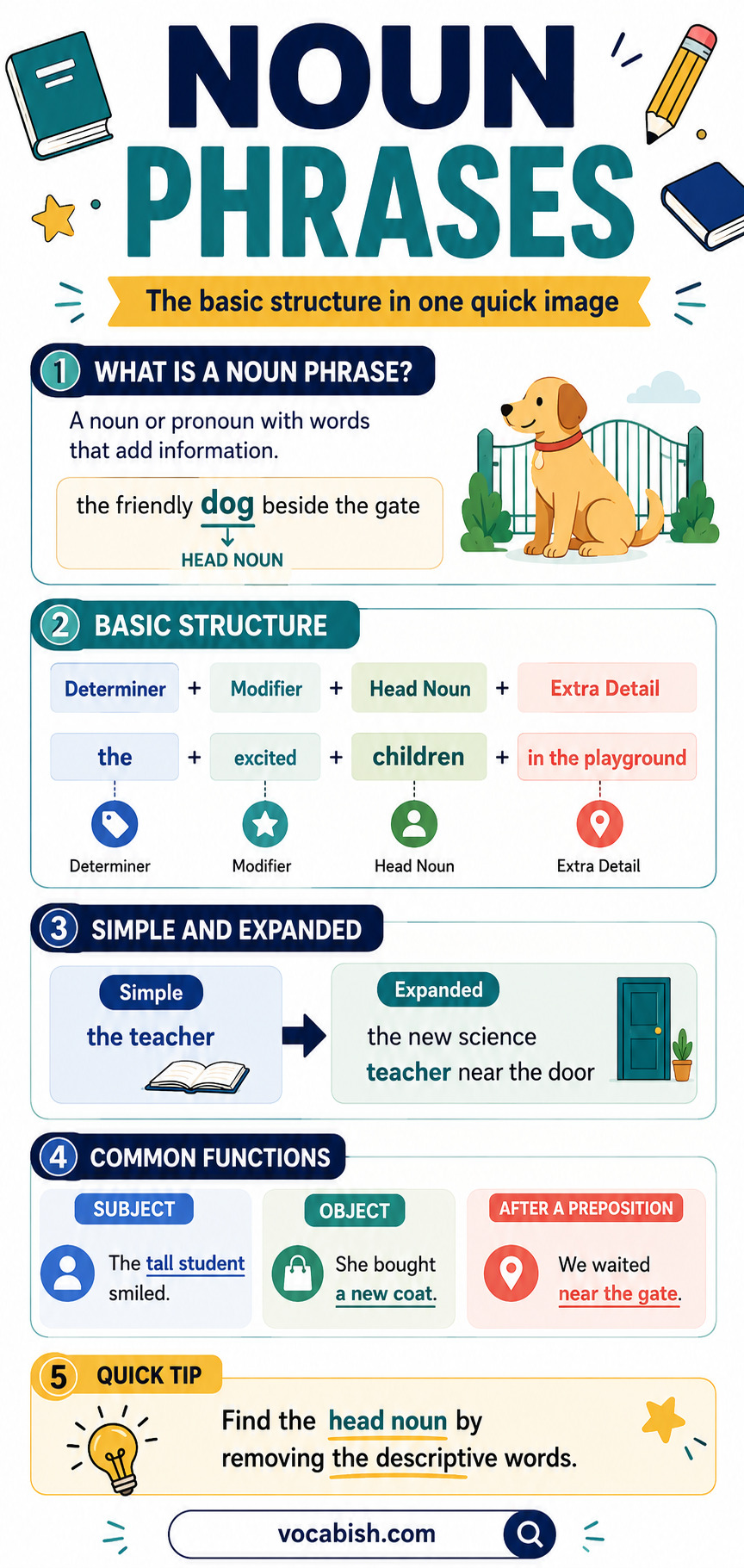
A sentence often needs more than a single noun to identify a person, place, object, or idea clearly. Instead of saying dog, we might say the friendly dog beside the gate. This complete group of words is a noun phrase.
Noun phrases help speakers and writers add useful details without creating several separate sentences. They can be short and simple or expanded with adjectives, prepositional phrases, and clauses.
What Is a Noun Phrase?
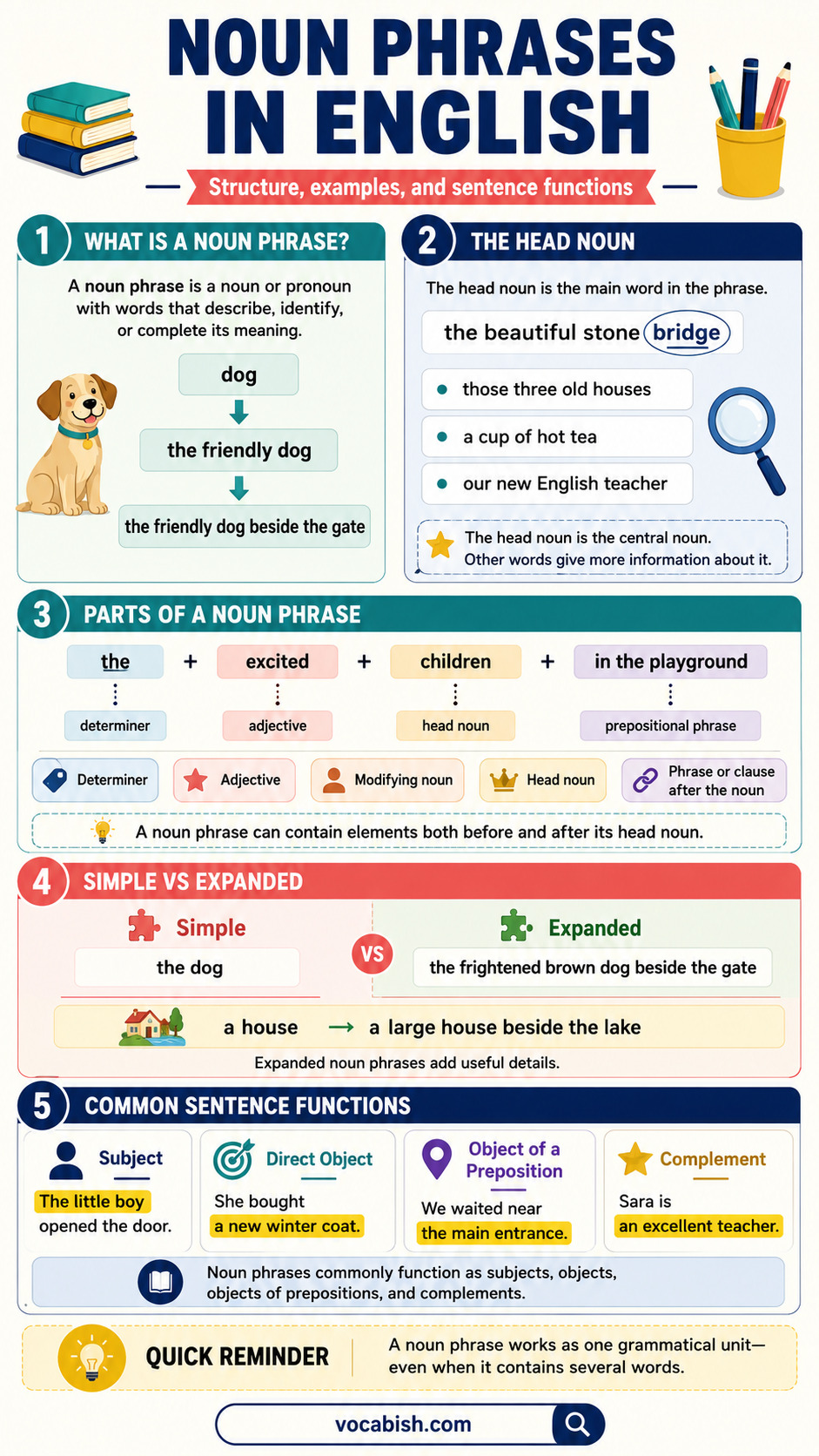
A noun phrase is a noun or pronoun together with the words that describe, identify, or complete its meaning. The entire phrase works as one grammatical unit.
- children
- the children
- the excited children
- the excited children in the playground
In the sentence below, the complete noun phrase acts as the subject:
The excited children in the playground waved to us.
A noun phrase does not always contain several words. A single noun or pronoun can also function as a noun phrase:
- Sara smiled.
- Birds were singing.
- They arrived early.
The Head Noun
The head noun is the central noun in a noun phrase. Other words provide information about it.
Noun phrase | Head noun |
|---|---|
the red bicycle | bicycle |
those three old houses | houses |
a cup of hot tea | cup |
the woman near the window | woman |
our new English teacher | teacher |
One way to find the head noun is to remove the descriptive words:
- the beautiful stone bridge
- the bridge
- bridge
The phrase is mainly about the bridge, so bridge is the head noun.
In a phrase such as a box of chocolates, the head noun is box, not chocolates. The phrase names a box and then explains what it contains.
Parts of a Noun Phrase
A noun phrase can contain words before and after its head noun.
Position | Possible element | Example |
|---|---|---|
Before the noun | Determiner | the house |
Before the noun | Adjective | the large house |
Before the noun | Modifying noun | a garden wall |
Central position | Head noun | the large house |
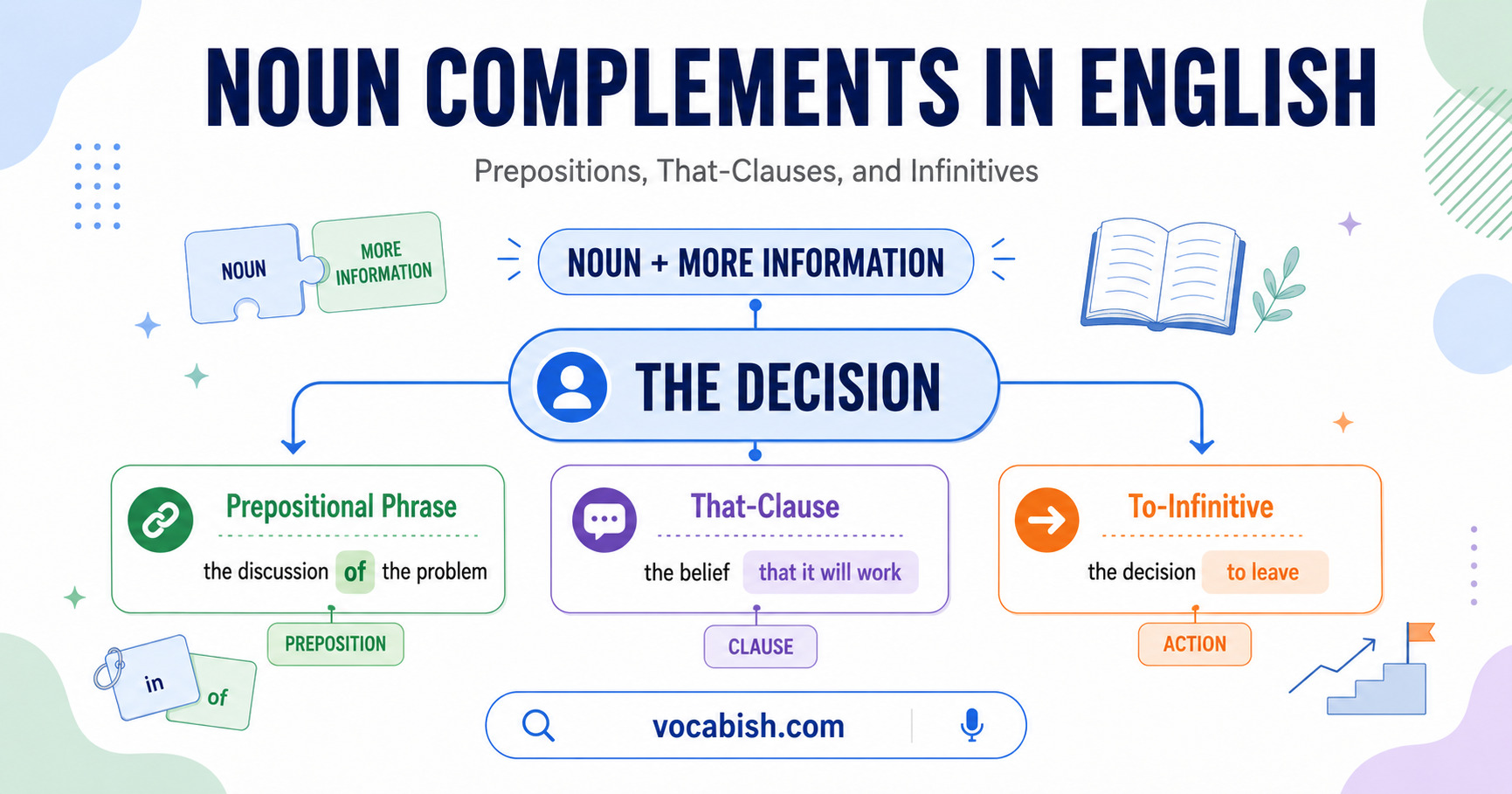
After the noun | Prepositional phrase | the house on the corner |
After the noun | Relative clause | the house that we visited |
Not every noun phrase contains all these elements.
Determiners
Determiners introduce or identify the head noun. They usually appear at the beginning of a noun phrase.
Common determiners include:
- Articles: a, an, the
- Demonstratives: this, that, these, those
- Possessives: my, your, his, her, our, their
- Quantifiers: some, many, several, enough
- Numbers: one, two, twenty
- Distributives: each, every, either, neither
Examples:
- an interesting book
- those noisy neighbours
- my first job
- several useful suggestions
- every student in the class
A singular countable noun normally needs a determiner:
- Incorrect: She bought new laptop.
- Correct: She bought a new laptop.
Adjectives
Adjectives describe the head noun. One noun phrase can contain one adjective or several.
- a quiet street
- the small wooden table
- her beautiful blue dress
- an unusually difficult question
When several adjectives appear together, they usually follow a natural order:
opinion → size → age → shape → colour → origin → material → purpose → noun
Example:
- a beautiful small old round brown Italian wooden coffee table
Long strings of adjectives can sound unnatural. Use only the details that readers genuinely need.
Nouns Used as Modifiers
A noun can appear before another noun and describe its type, purpose, material, or connection.
Noun phrase | Modifying noun | Head noun |
|---|---|---|
school bus | school | bus |
coffee cup | coffee | cup |
kitchen table | kitchen | table |
football match | football | match |
office manager | office | manager |
The modifying noun is usually singular:
- shoe shop
- car door
- ticket office
Some established expressions use plural forms:
- sports centre
- clothes shop
- arms race
The final noun is normally the head noun. In coffee cup, the phrase refers to a type of cup, not a type of coffee.
Prepositional Phrases
A prepositional phrase can follow the head noun and add information about place, time, possession, content, or connection.
- the keys on the table
- a woman with curly hair
- the meeting after lunch
- a bottle of water
- the road to the village
The prepositional phrase belongs to the noun phrase when it describes the head noun:
The keys on the table are mine.
Here, on the table identifies which keys the speaker means.
Compare:
- She placed the keys on the table.
In this sentence, on the table explains where she placed the keys. It modifies the verb rather than forming part of the object noun phrase.
Relative Clauses
A relative clause follows a noun and gives more information about it. It often begins with who, whom, whose, which, or that.
- the student who answered the question
- the film that we watched
- a woman whose car was stolen
- the shoes which I ordered online
The head noun comes before the relative clause:
Noun phrase | Head noun | Relative clause |
|---|---|---|
the man who called yesterday | man | who called yesterday |
the book that you recommended | book | that you recommended |
the house which stands near the river | house | which stands near the river |
The relative clause contains a verb, but the complete expression remains a noun phrase because its main element is a noun.
Simple Noun Phrases
A simple noun phrase contains a head noun with few or no modifiers.
Examples:
- books
- the teacher
- my phone
- several students
- an interesting idea
Simple noun phrases are common when the listener already knows which person or thing is being discussed.
- The teacher entered.
- I lost my phone.
- Several students volunteered.
Expanded Noun Phrases
An expanded noun phrase adds more information to the head noun. It may include adjectives, modifying nouns, prepositional phrases, or relative clauses.
Simple noun phrase | Expanded noun phrase |
|---|---|
the dog | the frightened brown dog |
a house | a large house beside the lake |
the woman | the woman wearing a red coat |
a book | the history book that you lent me |
those students | those hardworking students in the front row |
Expanded noun phrases make descriptions more specific:
- A car stopped outside.
- A large black car with tinted windows stopped outside.
Extra detail should have a purpose. An unnecessarily long noun phrase can make a sentence difficult to follow.
Noun Phrases as Subjects
A noun phrase can act as the subject of a sentence. It tells us who or what performs the action or experiences a condition.
- The little boy in the blue jacket opened the door.
- My two closest friends live abroad.
- The broken window near the entrance needs replacing.
- Several people from our office attended the event.
To find the subject, ask who or what performs the verb:
The little boy in the blue jacket opened the door.
Who opened the door?
The little boy in the blue jacket.
Noun Phrases as Objects
A noun phrase can receive the action of a verb.
Direct object
A direct object answers what? or whom? after the verb.
- She bought a new winter coat.
- We watched the documentary about sea life.
- The manager interviewed three experienced candidates.
What did she buy?
A new winter coat.
Indirect object
An indirect object usually identifies the person who receives something.
- She gave her younger brother a gift.
- The teacher showed the new students their classroom.
- I sent my closest friend a message.
In She gave her younger brother a gift:
- her younger brother = indirect object
- a gift = direct object
Noun Phrases after Prepositions
A noun phrase can appear after a preposition. It then acts as the object of that preposition.
- under the old wooden bridge
- beside a quiet country road
- with her two younger sisters
- during the final week of school
- without any clear explanation
In complete sentences:
- We waited near the main entrance.
- He travelled with two friends from university.
- The cat slept under the dining-room table.
- They talked about their plans for the weekend.
The preposition itself is not part of the noun phrase:
- Preposition: under
- Noun phrase: the dining-room table
- Complete prepositional phrase: under the dining-room table
Noun Phrase vs Noun Clause
Noun phrases and noun clauses can perform similar jobs, but their internal structures are different.
Feature | Noun phrase | Noun clause |
|---|---|---|
Central element | Noun or pronoun | Subject and verb |
Contains a complete clause structure | No | Yes |
Can act as a subject | Yes | Yes |
Can act as an object | Yes | Yes |
Example | the correct answer | what she answered |
Compare these sentences:
- Her answer surprised everyone.
- What she answered surprised everyone.
Her answer is a noun phrase centred on the noun answer.
What she answered is a noun clause because it contains a subject, she, and a verb, answered.
More examples:
Noun phrase | Noun clause |
|---|---|
his reason | why he left |
the winner | whoever finishes first |
the meeting time | when the meeting begins |
her decision | what she decided |
A relative clause inside a noun phrase does not turn the entire noun phrase into a noun clause:
- The answer that she gave was correct.
The complete expression is a noun phrase. Its head noun is answer, and that she gave is a relative clause modifying it.
Common Noun Phrase Errors
- Missing a determiner
Incorrect: I bought new phone.
Correct: I bought a new phone. - Using the wrong adjective position
Incorrect: She wore a dress red beautiful.
Correct: She wore a beautiful red dress. - Making a modifying noun plural unnecessarily
Incorrect: a shoes shop
Correct: a shoe shop - Choosing the wrong head noun
In a group of students, the head noun is group, not students. - Creating an overloaded noun phrase
Unclear: the large old damaged wooden dining-room table near the window with broken legs
Clearer: the old dining-room table near the window, which had two broken legs - Confusing a noun phrase with a noun clause
Noun phrase: his unexpected arrival
Noun clause: when he unexpectedly arrived
Practice Exercise
Identify the complete noun phrase in each sentence. Then write its head noun and grammatical function.
- The tall student near the door raised her hand.
- We visited an old castle on the hill.
- They spoke to the new science teacher.
- A basket of ripe peaches sat on the kitchen counter.
- My younger brother’s football boots are muddy.
- The woman who lives upstairs owns two parrots.
Decide whether the bold group is a noun phrase or a noun clause.
- What she said surprised everyone.
- The message on my phone surprised me.
- I remember the place where we met.
- I remember where we met.
Expand each simple noun phrase by adding suitable details.
- the dog
- a building
- those people
Answer Key
- The tall student near the door
Head noun: student
Function: subject - an old castle on the hill
Head noun: castle
Function: direct object - the new science teacher
Head noun: teacher
Function: object of the preposition to - A basket of ripe peaches
Head noun: basket
Function: subject - My younger brother’s football boots
Head noun: boots
Function: subject - The woman who lives upstairs
Head noun: woman
Function: subject - Noun clause
- Noun phrase
- Noun phrase containing the relative clause where we met
- Noun clause
Possible answers:
- the friendly brown dog beside the gate
- a modern office building in the city centre
- those helpful people who gave us directions
Other grammatically correct expansions are also possible.
FAQs About Noun Phrases
A noun phrase is a noun or pronoun with any determiners, modifiers, or complements that work together as one sentence unit.
Yes. A single noun or pronoun can function as a noun phrase when it stands alone as a subject, object, or complement.
The head noun is the central word. Remove the modifiers, and the remaining noun usually shows what the whole phrase names.
A noun phrase centres on a noun or pronoun, while a noun clause contains a subject and verb and performs a noun’s job.
Yes. Pronouns such as she, them, someone, and those can form complete noun phrases without needing a separate head noun.
Determiners, adjectives, possessives, modifying nouns, prepositional phrases, participle phrases, and relative clauses can all add information to the head noun.
Expanded noun phrases add precise details about people, places, objects, or ideas, helping sentences become clearer, more descriptive, and less repetitive.
Short Summary About Noun Phrases
A noun phrase is built around a head noun or pronoun and works as one unit in a sentence. It may include determiners, adjectives, modifying nouns, prepositional phrases, and relative clauses.
Noun phrases can function as:
- Subjects
- Direct or indirect objects
- Objects of prepositions
- Complements
Simple noun phrases contain little detail, while expanded noun phrases provide more specific information. Unlike a noun phrase, a noun clause contains both a subject and a verb.
You May Also Like
- Gender of Nouns in English Grammar
- Functions of Nouns in a Sentence
- Possessive Nouns Definitions and Examples
- Differences Between Parts of Speech
- Common Nouns Explained in English
- Proper Nouns Explained with Examples
- Concrete Nouns with Examples
- Abstract Nouns in English
- Countable Nouns Definitions and Examples
- Uncountable Nouns Rules and Examples
- Collective Nouns in English with Types